
Episode 36: When Discomfort Is the Path to Connection with Annmarie Chereso
What if the real work in relationships isn’t avoiding discomfort, but learning how to stay present when it shows up?
In this episode, Stephanie is joined by Annmarie Chereso to explore how conflict, discomfort, and emotional activation shape our relationships with our partners, our children, and ourselves. Annmarie shares how her own life experiences, including single parenting, divorce, and raising a highly sensitive child, pushed her to look at how fear and threat responses were showing up in her nervous system and relationships.
Together, they unpack the difference between reacting from fear versus responding from trust, and why so many of us were never taught how to tolerate discomfort without shutting down or creating resistance.
This conversation weaves through parenting, boundaries, conditioning around being “good,” and how learning to sit with discomfort can actually open the door to deeper connection.
-
This is Redefining Us, and I'm your host, Stephanie Konter O'Hara, licensed professional counselor. And I'm so glad that you joined us today so we can dive into what it means to be a woman in today's society. Figuring out how we balance everything, how we grow, how we be more authentically us, and figuring out who we are through the transitions of life, whether that be motherhood, success, relationships, and all things that happen in women's lives, because it's definitely not a linear journey. And I think by talking about it and normalizing it and validating, we can all arise together and be the women that we were meant to be. So keep tuning in, and I am so excited about joining the conversation and being in your ears each week. Let's get into it. Welcome back to Redefining Us. I'm your host, Stephanie Conter O'Hara, and today we're talking with Anne-Marie Churseau. She is a conscious relationship coach, an international best-selling author and speaker based out of Chicago, Illinois. She helps women unravel old patterns, reconnect with their inner wisdom, and create relationships rooted in trust, love, and a deep self-awareness. And her true mission is to guide women back to their most empowered and authentic selves. So I'm really excited for you to hear this podcast today and dive into it with us. Welcome, Anne-Marie Tereso. So excited to dive in today. So I would love to hear your background story of why you have taken the route that you have taken to do the work that you're doing. So yeah, I would love for you to share that with me and the listener.
Yeah, well, thanks for having me. Um, background story. So I've told this story so many times I feel a little bit like a broken archie. Um, my sort of catalyst was when I was eight months pregnant. Actually, when I was six weeks pregnant with my third child, I discovered my husband was having an affair. My marriage started to crumble, life started to fall apart. And when I was eight months pregnant, he moved out. And then, you know, the whole castle came crumbling down. And of course, that was the moment, right? That's the choice point. Like, okay, well, what are we gonna do with this experience in our life? We can either crumble under the rubble, which I did for a long time, and then I slowly started to come out from under the rubble and wake myself up and really take more responsibility for my life and how I was co-creating my life. And what are the things that I needed to take a look at and take responsibility for so that I can be more empowered in my life. And that translated in so many ways, you know, translated in my intimate relationships, it translated in my role as a mother and a parent big time. It's where I got most of my lessons. It translated in my work in the world, it translated in my friendships, it translated in my adult relationships with my family system. So I could just see how I was the common denominator and all the things that were going on. And the only thing I could really change or do was myself. So I started to put my attention on that. And when I started to learn the things that I was doing and participating and co-creating, I was sort of like one of those little chin grabs, like, well, hmm, if that's happening for me, I wonder if it's happening for other people. So I so it led me into the world of coaching and supporting others to be of service to others who wanted to wake up on their journey.
Yeah. I just want to say that's a really challenging time for your life to kind of be turned on its head by having another child enter into your life and becoming a parent again for a different individual. Like every child is so different. So I can understand why you might have experienced being in the rubble for a while. So yeah, I just want to validate that for you because that's a that's a lot, that's already a pivotal time. And then you will have this other thing that feels outside of your control, just much as a new child is outside of your control, like happening simultaneously.
Oh, yeah.
And boy, was she out of control. Like, I just wanna she just gave me a run for my money. My first two kids were textbook, they were easy. I mean, they were like kids, they did stuff, but they were pretty useful. And then she came along and she's like, Oh no, oh no, no, no. This is I mean, you're getting your PhD in parenting over here.
Yeah, for sure. That's funny. Well, yeah, I guess what were some of the things that you found that really helped you navigate these relationships and parenthood differently within yourself that you noticed needed to change?
I think the the biggest thing I learned that there's a real big difference to being in relationship to others from a place of love or from a place of fear or threat. And when I started to track that in me when I was relating to, for instance, my highly triggered, anxious newborn baby from a place of threat or fear, I entered this sort of zone of disempowerment and I was sort of scrambling. It's sort of like you're drowning and you're like you don't have a life vest, and you're just sort of barely keeping your head above water, trying to figure out how to stop this runaway train that you feel like you have no control over. When I started to learn that, oh, actually I'm quite empowered when I'm in a place of trust or real love, then I could access the tools that I needed to access to create the experience I wanted to create in the moment, no matter what was going on. But when I related to life, like I was at the effect of what was happening and I had no control or power over it, man, I just created mess after mess after mess, much like all of us do.
Yes, I think when we feel like we're only a passenger in our life, rather than the words you use were like co-creator. I think we oftentimes can just, I don't know, let go of the wheel and hope that things work itself out, but we really at least need one hand on the wheel in order to bring our life to a place of peace and harmony and ease. Yeah.
That is like as you were talking about that, I was imagining that time in my life. I'm like, I wasn't even in the passenger seat, I was in the trunk of the car. Like I didn't even realize there was a car. I was just in the trunk, you know, like hunkered down, hanging on for dear life. And but I do love this analogy of being either a passenger or a driver in the driver's seat of your life. And I don't think many of us were taught from a young age that we we do we do have the wheel of the car. We are in charge. And when we believe that and trust ourselves, all these things that we think we have trouble with boundaries, you know, conflict, right relationship, integrity, all that stuff is really useful when you're when you realize you're in the driver's seat and you have the wheel and you have your foot on the gas and you have the key, like you have all the things. Yeah. So it you just need to get related to that to really understand the truth of who you are.
Yeah. I would imagine there's maybe this theme of I'm gonna, I guess throw my parents under the bus, maybe the older generations under the bus, of like these things are happening to us, and we have to kind of respond to them or react to them, not necessarily like proactively set out to go down this road. I kind of remember my parents kind of in a lot of good ways trying to be protective, like taking my hand down the road to what I was supposed to be doing or what I was supposed to be, and trying to figure out like, oh, I don't need to just go down this road of what somebody else is telling me I should be, or allow things to just happen to me. Like I need to kind of have my own hands help guiding me down the road that I want to go down, not the road that I was told to go down or that I should go down. And I think that takes a lot of insight to realize that you're holding someone else's hand.
Yeah.
And they're taking you down a road, or like you're letting the universe or the world hold your hand and take you down a road. Like, no, no, I can have both of my hands and help them, you know, guide me down the path that I want to go down.
Yeah. And I that piece about where do I want to dep, right? That's this idea of being a sovereign being and that there isn't a right way or a wrong way. It's what's my way, and getting aligned with that, and then really being devoted to what's my way? What is my my way and how is can I best serve that? Which doesn't mean trampling over others and running over other people in the car or letting go of people's hands completely, but it just means honor your path and get out of this polarity of there's a right way and there's a wrong way, there's a good way and there's a bad way. There, you know, and there's just a way. And staying in alignment with that is really hard because of how we've been raised and how we've been programmed by our culture and our family systems and conditioned by all of that. So stripping all that away and finding and reconnecting with like what is my way? What you know, if I can stay in integrity with that, you know, I have an example that just came up with my daughter. I don't have permission to share this, but I'm pretty sure it's okay. It just came up this morning, but she's in her mid-20s now and she's a college student, she lives at home, and she has a boyfriend who lives in this, you know, 35 minutes or 30 miles away or something. So the commute is difficult for them. And she's in finals, she's in this final stretch, and she's feeling some stress. And they have an arrangement where she goes to his house once a week and he comes here once a week, and it's a really lovely arrangement that they have, but uh tonight or tomorrow night's her night to go there, and she doesn't want to because she's feeling too much stress, she's got too much going on, and she knows herself and she knows she needs space. And it's not that she doesn't want to see him or spend time with him, and he has been coming here more, you know, she's got all this guilt and shame. Like he's been giving more than I'm giving. I should go there because it's the right thing to do. And I just sat with her for a moment and I'm like, but what is right for you? Because if you're not showing up with what is right for you, you're gonna go there and not be very fun to be around. You're abandoning yourself, and you have to get out of that pattern. And um, you know, I don't know what she's gonna decide to do, but it's bumblewash.
Yeah, I think this uh shame or guilt piece, I think, oftentimes propels us to violate our own boundaries or violate what's really in alignment with us to please someone else or to please this idea of doing what's right. It can be a difficult trap that a lot of people don't even realize they're falling into.
Yep. And it all comes from our conditioning around wanting to be perceived as good versus bad. And if we don't get to that conditioning, we're gonna continue to make decisions and choices that are out of alignment for ourselves because we are more attached to being perceived as being good than we are and staying in alignment and true to ourselves.
Yeah, it would be so nice, I feel like, if we could figure out how to change as a culture to almost unteach this idea of doing what's good or being perceived as good. It's just so embedded, like whether you're at school or whether you're at work or whether you're in relationships with your family members, it's almost in all of these cases that being seen as agreeable or easy or whatnot is the desired outcome of how you should show up.
Yep. It's so in our culture, it's particularly embedded in, you know, women showing up in a particular way, being amenable, being cooperative, not being difficult. And I see it in my daughters, my grown daughters. And they did not necessarily grow up in a home that values that. I can't say that I completely didn't teach them any of that because it lives in me. So I'm sure it's translated, but I have an awareness around it and I pay attention to it. So I can't even imagine when we're being raised in homes that are completely unaware. We're just passing down those beliefs from one generation to the next. So changing the culture is is a big ass.
Yes, it is.
So if we can just change ourselves to start, it's a start.
Yeah, for sure. Yeah, I have a two-year-old daughter, and there are some times where I think to myself, just in my head, like, can you please just get in the car? Or like, can you please just like let me get your coat on? And then I try to remember it's okay if she's mad that she doesn't want to do it, and tell her it's okay. But at the end of the day, we still have to get to school. You don't have to wear your coat, but you will be cold. Obviously, much smaller problems, but I can see it in myself of like, just do what I'm asking, please.
Well, and be a good girl and get your coat on, right? Like, do you remember? I got those messages when I was little. I used to get messages when my mom used to take the kids, God bless her, she's amazing and I love her. But he used to take my kids a lot when they were young, and she would report back to me and she would say things like he was really good. He he ate his dinner for me. And I'm like, Well, he did not eat for you at all. He ate for himself. Or she would say, you know, like he pooped for me. And I'm like, no, he didn't. So she would equate these things, like, they're really good. They listened to me. And now I understand that was just her conditioning and the way she was raised and all that. There's no problem there, but I could see it from a different perspective. You know, I was I was a a step away from it. And I was like, oh, I I remember feeling good or bad if I ate my dinner or didn't eat my dinner, or if I listened or didn't listen. Like there was ways in which I made this unconscious connection between my wholeness and goodness if I was putting my coat on when you wanted me to. And you know, we gotta they gotta get the coats on. Like it's uh so there's all of that, but there's a way in which we've all been conditioned around these ideals that are just not true.
Yeah, yeah, and trying to move to more neutral language. Uh, this is what I try again. My daughter's only two, so doing the best I can. But sometimes I tell myself, it's not good or bad that she gets the coat on, right? If she doesn't put her coat on, she will be cold. Like she will just so what I say to her is if you're not gonna put your coat on, that's fine, but you will be cold. And if you change your mind, your coat's here. So I try to avoid like be a good girl and put your coat on, or like be a good girl and eat your food. These are the consequences. Obviously, she's only two. I don't know how much she actually conceptualizes this, but these are the choices. You will experience the consequences. I'm letting you know what the consequences will be, or what I perceive the consequences will be if you don't do the thing that I'm suggesting.
I think that's so brilliant. And I don't even know. I was not able to do that when my kids were two, because I was like, damn, Philong, you know, like three kids and you got to get out the door and you're like, just agree with me. Slicking hard, but I'm saying she's only two and you don't know how she's taking it. My belief is these are the formative years, and she's taking it in, and allowing her to have those natural consequences is so important because they get it so quickly. I used to teach mindfulness in classrooms to preschoolers, and they were three, four, and five years old, and you would teach them these things and they got it instantly. But I would teach it to the 12th graders, and you know, they would be muddling around, and the parents forget about the parents would be like so up in their head they couldn't connect the dots. But the three, four, five-year-olds right away, they get it right away. So she's gonna know right away, I'm cold. Coat is hopeful, don't touch the stove, it's hot, you know. Like yeah, we learn very quickly when we're little, and we don't need a lot of reminders. Yeah, we don't need a lot of reminders. It's just like, oh, it's cold. This doesn't feel good. I'm gonna correct that. Thanks, mommy, for being here with me. Yeah, yeah.
The getting in the car thing, it's like this is what's happening. Like, you don't really get a choice. It's hard, I feel like, as a parent, when the option, there is no really other option. Like, this is the option. I think it's just important for maybe parents to be mindful of removing the good and bad. Like, this is what's happening. You can be obsessed. Yes, I'm and then even for yourself, too. Like, I'm not good for going to see my my boyfriend, or I'm not bad for not going to see my boyfriend. Like, I'm just he might be upset, and I'm gonna tolerate that distress, he's gonna tolerate that distress, and then we're just gonna move on. It's gonna be uncomfortable. Like sometimes this good, bad thing. I think we try to prevent ourselves from feeling uncomfortable, and like spending a full life presenting, preventing ourselves from feeling uncomfortable. Let's yeah, we might just need to let ourselves feel uncomfortable and figure out how to deal with that distress.
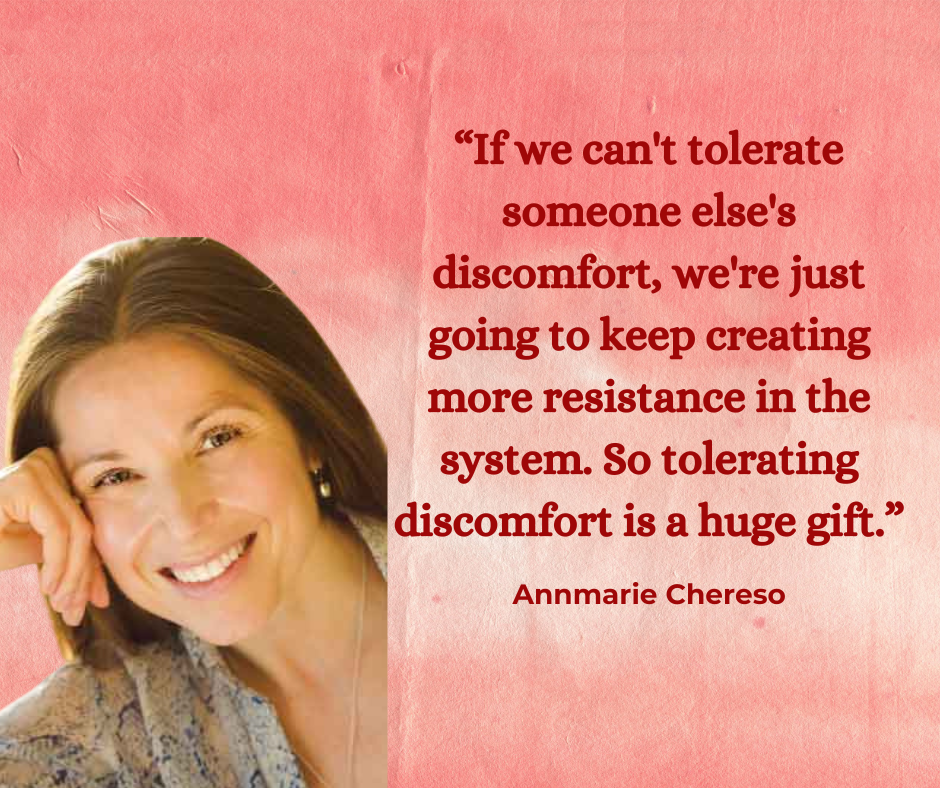
I think that is the single most important job of a parent is to help our kids learn how to be uncomfortable. And like going back to that code example, like she's gonna be cold and uncomfortable. And you're there to say, well, here's a solution, and you can take it or not take it. You have free will, and I'm here for you. And yeah, you're gonna survive being uncomfortable. But the thing we don't do in this culture is we do not teach our kids how to be uncomfortable. And my 21-year-old daughter is an example. She's like, I don't want to upset him, I don't want to make him mad, you know. I'm like, why? Why don't you want to do that? And of course, it's she like, I don't want to deal with the conflict. And I do a lot of programming around from conflict to connection is sort of my tagline and the thing I do. And I think it's a real barrier because if we can't tolerate someone else's discomfort, we're just gonna keep creating more resistance in the system. So tolerating discomfort is a huge gift.
Yeah, even my adult self who's been to therapy for I don't even know how many years since I was like 20. So 17 years, I find myself almost like prepping people, like I'm about to tell you something that probably is gonna make you uncomfortable. Right. And it rather than just saying the thing, and I that's like my I think growth edge right now. Like I've learned to say the thing that's going to make them uncomfortable because they're probably not gonna like what I have to say, but then I have to preface it with you're probably gonna be upset with this.
Yeah, my husband does that to me all the time, and then he says that and I'm like, When are you gonna say the thing that's gonna upset me? He's like, I just said it.
No, that was not a winner. I'm not upset by it. Yeah, I'm just a preference, it's fine. But yeah, I think that's I mean, it's not a bad practice to set people up for success.
And yeah, but also the you could be setting them up and they have you know, no, like they're not even upset at all. So who knows?
Yeah. I guess I I point that out there's layers of learning how to say a thing that's hard.
Yeah.
Like you're probably just not gonna day one be ready to just say the hard thing. So maybe be mindful for those that are listening that like it's not an easy band-aid to just rip off.
I have a hack. You want to hear it? Yeah, I'd love to. I love you. I love you, and I love you, and I can't drive out there today. I I love you, I really want to see you, and I can't. And I forget that a lot. That's my hack, and I forget it still, because we get sort of stuck in our own fear, like uh, I don't want to upset them. I don't, I don't want to be dis, I don't want to disappoint. And so we'll be down there scrambling, and then we're just forgetting the reason we're scrambling is because we care so much about this other person and their needs. And if we just lead with that, because that's what the that's what's true. I love you and I don't want to disappoint you. I love you and I don't want you to be mad. I love you, and I love you, and you have to put your coat on. I love you, and you have to get in the car. I like that I I love you, and this is uncomfortable. I I am sorry, but you know, I love you and. So that's my hat. I think that's a good hat.
I think if we lead with the connection piece, then hopefully the conflict part won't damage the relationship in a way that we're afraid of. Yeah, exactly right. Or if it does impact the relationship, they've at least heard the message first that you care about them.
Yeah. Yeah. Leading with love.
Yeah, leading with love rather than leading with fear. I think there, I would imagine there's a decent amount of people, just based on the clients that I've worked with in my life, that lead their life with this sense of something bad is about to happen, or they're waiting for the other shoe to drop and just acknowledging that the other shoe doesn't need to drop. And if it does, you've led with love first. So you've led with connection or kindness or a sense of this desire to maintain the relationship.
Yeah. If you're staying in that the higher vibrations of love and connection, empathy, compassion, if you sort of stay there, you're creating more opportunity for connection. And really it's connecting with yourself first, your sense of empathy, your sense of love. And when you open that doorway to your own heart, people automatically step in. And so when you when you say like I love you, and you really mean it and it's true, and you feel it, people resonate with that. It's an energetic vibrational frequency that people just sort of swoop into, you know, your kids feel it. We feel it from one another. And when we lead from that place of fear, we're gonna invite people to join us there. And we're gonna create contraction and we're gonna create defensiveness and we're gonna co-create um resistance. And that's that's not what we want. But what's interesting is you create what you believe, right? So if you start with fear, I'm gonna create I'm gonna create an argument, and you start from I don't want an argument, you're gonna probably get an argument. But if you start from, I really want connection with you, then you're more likely to get it. Now, I tell people and my clients, you can't guarantee it. You don't know how other people are gonna respond. So you do your best and you start with an open heart, and either people are gonna walk in, walk in or not. And but all you can do is control your side of the equation.
And if there is conflict that erupts because the other person is triggered for whatever reason or uncomfortable for whatever reason, the thing that you said. Like, I don't know, I I guess I think to myself, the same idea you would do with a child because you came in co trying to co-regulate with them, like they will respond eventually with a co-regulated response. It might take them a moment, they might get dysregulated and go outside of the window of tolerance initially, but the likelihood of them staying outside of that window of tolerance, like long term, is probably less likely and come back into the window of tolerance and be able to meet you in that regulated place.
Yeah, this is the thing that I did not know how to do early in my parenting. And this was the gift of my third child because she was constantly dysregulated. She was constantly in this, like just she was in a constant dysregulated state, which uh was really just mirroring back to me what was going on in me. I was like a single parent with a newborn, two toddlers, and a disastrous divorce. And I mean, it was just a m, I was a mess. And she basically grew in this dysregulated nervous system because the whole pregnancy I felt that way. And she came out just kicking and screaming and colic and crying 12 hours a day. And for seven years we were navigating all this, and I didn't understand how to co-regulate with her. So all she got from me was resistance. I just kept trying to push her down and get her to stop. And I didn't understand that I have to come over here and reparent my parts and you know, get into a higher vibrational frequency. I don't know how else to say that without sounding super woo, but you get what I mean. Like I had to manage my own nervous system, get into what I call homeostasis or home base, reconnect with my myself again. And then it reminded her of herself. And then slowly, like you said, it takes time, but slowly they will co-regulate with you. It's easier with kids and it's harder with adults because we're conditioned much longer. So it takes longer to trust that and get back to that place.
Mm-hmm. Yeah. And it's all depending on what you're going through too. Like for myself, and I've shared this on the podcast before, like when my daughter was first born, I think because of just a compounding of factors, I was pretty dysregulated. And I would try because of again, I as a therapist, I knew this idea of regulation. I would try to co-regulate and try to co-regulate. And it would take me so much longer to co-regulate with her because I was so dysregulated. But I just kept trying and kept trying and kept trying. And it, I mean, it it took time, but eventually we were able to regulate with each other. But and I I think sometimes when something's hard for us, we might just be like, I'm giving up on this. Like, this doesn't work. But I wanted to tell parents it does work if you're in that postpartum piece or if you're, you know, dealing with a five-year-old who's just throwing food everywhere and it's hard to not be like, ah, or whatever age your child is, just try to keep showing up in a regulated way as much as you can, because eventually you'll be able to come together. But yeah, I want to just name it, even though it sounds like we're just saying, oh, just be regulated, it'll be fine. It's not easy.
Like 10 years to figure out how to do it. Because first we're talking about it, right? So it's landing in the head, but it's an embodied experience and you need tools and resources and support to learn how to be in homeostasis or in your home home zone, home base, whatever you want to call it. And that took a lot of years for me to learn, particularly in the midst of one of the big tantrums or the throwdowns, because you're in your limbic brain, you can't access your thinking brain. So then you don't know how to apply the tools. Like there's so many steps involved. So for anyone listening in, it is not easy. It's possible, it's not impossible, it's more than possible to do. And I would encourage anyone and everyone listening in to get the tools, get the resources, and do it because it's improved my life. It's calmed my nervous system, it's reduced my stress, it's been a gift for me. And consequently for her as well. And I would say it was up until she's now 21. She was 18 when she went off to college. Um, she had a really traumatic experience. And it was just another opportunity to use those tools. And I could tell all the years that we've been planting those seeds really served her then. And I could say right now, yeah, like she's in a really good place. But it's been years and years of learning and unlearning and relearning for both of us. So yeah, I write about this. I co-authored a book this year called The Perfectly Imperfect Family. And in my chapter, I talk all about how I learned to do this, how she, her dysregulated state, taught me how to regulate and how important that was for me. And I, you know, I keep wanting to emphasize like 99% of parenting is all about us. Like our kids are just gifts to teaching us how to be more embodied in higher versions of ourselves. And my youngest daughter really, she really taught me a lot.
Yeah. And it's hard to listen to the lessons, right? But I think being willing to have an open heart and open mind to the lessons that our children are going to teach us is really important. And because I think parents enter into the role of a parent thinking that you're just gonna teach them stuff. Oh, yeah. Yeah, that's inaccurate. They're gonna teach you a ton of stuff, and it's our jobs as parents to be willing to listen.
Yeah. And learn and transform and evolve. Because that's what, in my experience, that's what it's been all about. My children have really helped me on my journey of transformation. And then they just mirror back to me what I've learned well and what I haven't learned well. So I get to keep learning.
Well, I'd love for you to share with us where people can connect with you and maybe a little bit more about your book so people can access that.
Yeah. People can find me, thank you, on my website. So Ian Mariechiresso.me, I'm sure you'll put that in your show notes. It's a tricky nick this bell. On there, you'll see I've authored two books, a children's book called Little Seeds Journey, and I've co-authored this other book called Perfectly and Perfect Family. Um, I have programs, I have a free quiz there. So you can take the free quiz that tells you what your conflict style is. So you can learn a little bit more about yourself there in a mini masterclass if anyone's interested in learning one simple question to transform conflict to connection. So those are some of my great free resources on the website. And then you can go to Instagram and all the other places, but that's a good place to start.
Awesome. Well, thank you so much for taking time to talk with me today and share with our listeners all of your insights and information. And yeah, thank you so much again.
It's such a delight. Thanks, Stephanie. Really great talking with you.
Thank you for tuning in to Redefining Us once again and share with other people so other people can continue to listen to Redefining Us and we can get into more listeners' ears if you follow us or subscribe or leave a comment or review. That would be greatly helpful for other people to find us and also just for me to get some feedback. What do you guys want to hear me say? What do you women care about hearing? I'm totally open to bringing on guests and talking about topics that are unique and inspiring to everyone, so please let me know. And this year, hopefully, we've full of a lot of community building, a lot of public speaking, a lot of resource sharing. So I really encourage you to follow us on social media at Wellminded Counseling on Instagram as our handle, as well as going directly to our website, longmindedcounseling.com backslash redefining us, so you can be in the know with all the things that are happening in the Redefining Us community. Once again, thank you so much for listening and keeping awesome.