Episode 44: Life Transitions | You’re Not Lost — You’re Becoming
We’re exploring the uncomfortable, emotional, and often lonely experience of identity shifts during major life transitions.
Whether it’s motherhood, marriage, career changes, aging, or simply evolving into a new version of yourself, there can come a moment where you look at your life and think:
“I don’t fully recognize myself anymore.”
Stephanie unpacks why this feeling is far more common than we realize — and why it doesn’t mean something is wrong with you.
She explores the emotional realities many women silently carry:
The identity loss and nervous system overwhelm that can happen in motherhood
Feeling emotionally disconnected or outgrown within marriage
Realizing a career no longer aligns with who you are becoming
The fear, grief, confusion, and uncertainty that come with personal evolution
Rather than viewing these moments as failure, we can choose to see them as evidence of expansion.
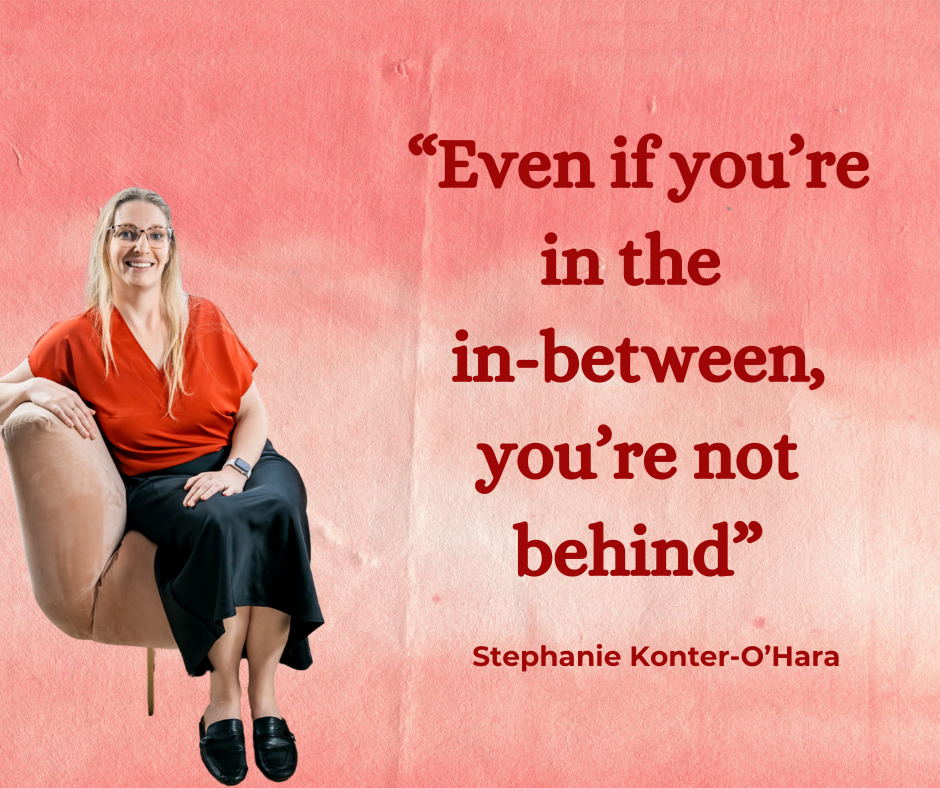
How amazing it could be to release the pressure of “having it all figured out” and instead learn how to move through transitions with more compassion, curiosity, and self-connection.
The episode also has practical tools for navigating the “in-between,” including:
Naming what feels off without immediately trying to fix it
Allowing yourself to evolve without shame
Making micro-decisions instead of drastic overhauls
Creating small moments of reconnection with yourself
Letting go of the belief that clarity must come immediately
If you’ve been feeling disconnected from yourself, uncertain about your next chapter, emotionally stretched thin, or afraid that you’ve somehow “lost” who you are — this conversation will remind you that you may not be lost at all.
You may simply be becoming.
-
This is Redefining Us, and I'm your host, Stephanie Konter-O'Hara, Licensed Professional Counselor. And I'm so glad that you joined us today so we can dive into what it means to be a woman in today's society. Figuring out how we balance everything, how we grow, how we be more authentically us, and figuring out who we are through the transitions of life, whether that be motherhood, success, relationships, and all things that happen in women's lives, because it's definitely not a linear journey. And I think by talking about it and normalizing it and validating, we can all arise together and be the women that we were meant to be. So keep tuning in, and I am so excited about joining the conversation and being in your ears each week. Let's get into it. All right. Today's episode, we're gonna be really talking about transitioning in our identities and who we are. This podcast, after all, is called Redefining Us. So I figured I'd circle back to the main idea behind this podcast and really think about yourself and going through different transitions and feeling like I don't know, I just don't fully recognize my life anymore. Things have changed so much, whether it be for marriage, motherhood, your career, just aging and your life transitions and you might find yourself feeling like I don't recognize who I am, but I also know that I can't go back to who I was. And it maybe it just feels off this transition time or being in this in-between. And I think that's really normal for people to experience these transitions and to be uncertain or confused about how to navigate them. So that's kind of what I want to dive in today. First, I just want to normalize that this happens to a lot of people, and it might be helpful to think about how you want to identify in the future. Are you wanting to identify as a mother? Are you wanting to identify first as a wife? Like what are your priorities of how what hat you want to be wearing? And it can be unclear and disorienting to kind of be asking yourself these questions. And so it's important that to remind yourself that you don't need clarity on what that new shift is, because it just hasn't maybe caught up with the growth place that you're in. And I think the confusion is just a byproduct of the expansion, it's not a dysfunction or means that something's wrong or that you're failing at your new role. Just it simply yeah, just that it just simply is indicating that yeah, something is new, something is different, and I'm still figuring it out. So there's a shift that of course happens with motherhood that I want to talk about. And I mentioned marriage and I mentioned career. So we're just gonna use those three things, three times in a woman's life that she may face to kind of like talk about this idea of transitioning and being in the in-between between identities. So when you become a mother, you'll have one identity before that is you, the individual. In transitioning into motherhood, now you have the identity of you and as a caregiver. You might have had roles and moments in your life, even prior to motherhood, that you may have stepped into for a time as a caregiver. However, when you have a child, fundamentally you are now in the role semi-permanently of a caregiver, right? Like your child is your child forever. So that identity or that role you will kind of permanently step into. And you might find yourself feeling like, who am I outside of being needed? You know, my child needs me all of the time, and it's taking all of my energy and my focus to be that caregiver for them, but like, who am I outside of being needed? And why does this feel harder than I expected emotionally? Right? Oftentimes people go into motherhood, maybe not clearly understanding the full picture of what motherhood's really going to look like. Some people might be super confident and super clear. I find that most people are a little underprepared for truly the shift that happens in their lives. You might find yourself feeling like you've lost some of your autonomy. You can't do what you want to do when you want to do it. There's all this invisible labor that happens that no one's paying you for, maybe no one's telling you a good job for. So I'm not going to dive into that in this episode, but I think it's important to know that like your personality or your identity might be shifting even in the way that you see yourself, because you're finding your behaviors being different than they were pre-motherhood. So a possible way to reframe this for yourself in the moment is you didn't lose yourself, you expanded, and now your system is trying to reorganize, right? Like you didn't lose yourself. You may have found yourself changing, you may have found yourself experiencing different things, but you yourself are still fundamentally you. And how can you go back to seeing that as a positive and allowing this expansion time to really help you reorganize the way that you show up and reorganize the way that you see yourself? Marriage is a different growth space. A lot of people in American culture now are living with their partners before marriage. So it may not feel like a cosmic shift, but there still is a shift in dynamics when someone commits their life to being married to another person. You might find that in your marriage that you are changing at a different rate than your partner's changing, that your partner might be going in one direction and you're maybe on the same direction, or maybe again going a different direction, and how it feels difficult to navigate these kind of ever-evolving transitions together, in that the dynamic may not suddenly work for you anymore the way that it was working before. Or you might find yourself feeling uncertain about where the dynamic shift is going between you and your partner, which can lead to some communication breakdowns potentially, because you may be nervous about sharing your concerns about the directions that the two of you are moving in. You might find yourself feeling emotionally lonely because you don't know how to talk about it or to feel, and you can unintentionally begin validating your own experience. And then resentments creep in. It's important to remember that your relationship isn't broken. You're just outgrowing the old structure. And if this is happening and you're uncertain of how to handle it and your identity is shifting in this, you know, there's some things that I would recommend. You know, talking to a therapist could be really helpful. Talking to your partner about your concerns directly can be really helpful. I think when our transition involves another person and it's not our own, I don't know, solo vacuumed identity shift, that can be really destabilizing to the relationship. And so if there is a communication breakdown, attempt to lean in and communicate what your concerns are in the best way that you know how and the most effective way that you know how. You know, there's plenty of resources that could be of service. There's a lot of things on the Gottman website. They've done a lot of research around how to speak to your significant other or to an intimate partner so you can potentially go about having those conversations with more confidence and more peace of mind. Um, but yeah, it's really unsettling when you're in the in-between of these growing stages. So again, if it's possible, seek support. You don't have to go through this transition, any transition, not just one in marriage, but any transition alone. Career. So this one is really interesting because I think this internal crisis that people have about their careers and the attachment that people have around their careers and their identity is so, so strong. And you might find yourself with this realization that I've built this career, but it doesn't fit me anymore. I've built this foundation for who I am as a worker, but it's not satisfying anymore. It doesn't fulfill me anymore. And that can be really uncomfortable because you might be thinking to yourself, like, goodness, I have 20 years left of working. I have 30 years left of doing this job. Can I change? Am I too old to change? Will I be able to find a new career? You might find yourself keeping yourself stuck by saying things like, Oh, I should just be grateful, or why am I so unhappy? I've done everything right. Like, what's wrong with me? Oftentimes, people really over-identify with their career and have it be linked to their level or satisfaction of their self-worth and their level of achievement. You might be finding yourself feeling some fear about starting over. Another thing that oftentimes happens is your career, depending on what it is, could be leaning, leading you to feeling burnt out because it's so demanding. It's making me almost think of an episode of the pit that I was recently watching, where you can really tell that plenty of the providers in the health field in that ER of the pit are feeling overwhelmed and burned out and like they don't know if it aligns with their ability to be happy, to continue in that in the roles that they're in. So that can be really scary to think about. Like, is my job leading me to feeling mentally and physically unwell that I need to change if I want to have a healthy, satisfying life. And something that could be helpful as a reframe for you if you're struggling with this is outgrowing something doesn't mean that you've made a wrong choice. It only means that you're evolving. That can be hard, right? Because like a career is feels like such a quote unquote choice, but it may also feel like something that you're you're stuck into, you're locked into. So trying to allow yourself to see it as a choice, as an opportunity, not something that you're locked into forever, can be really freeing. And I encourage people who are in this transitional place to be thinking about it in that way. I think it's really important to think about how you want to shift through this in-between. Maybe you wanna stop focusing on clarifying exactly what you're gonna do next. Maybe you just have to feel your way through what to do next. You might need to stop looking for specific pieces of like step-by-step advice and flow through it. I know that can be really scary because there's no clear path. However, I think if you let yourself feel through it and flow through it, in the end you'll have greater clarity. And again, this can be guided with resources and support. You don't feel you don't have to necessarily go through a transition alone, especially one that may feel unsettling. Some practical tools, name me what feels off. I feel like I don't know who I am anymore. I feel like my identity has shifted away from me as a person and me as a caregiver. Maybe it's you find yourself not feeling connected to your partner anymore and you don't know how to communicate that. Maybe it's I just hate what I'm doing day to day, and I feel like I need to get off this hamster wheel. So without fixing it, at least determining what is it that feels off. Because if you just feel off and you don't know why, insane in the in-between place can be for a long term, can be pretty uncomfortable. So, like, name it, identify, build awareness around why it feels uncomfortable. Again, without feeling like you need to immediately have a solution or without immediately moving into fix-it mode. It's important to remind yourself that you can make micro decisions that will slowly move you closer and closer to maybe where you want to be or where you hope to be. You don't need to just make some gigantic overhaul in one day or in one week in order to relieve yourself of the emotional distress that you're experiencing. It might just be these little choices allow you to have a little bit more relief. These little actions allow you to have a little bit more relief. Take the pressure off of just ripping the band-aid off and fixing it right this moment. Oftentimes that doesn't work. So figuring out how to move the needle bit by bit can be much more satisfying, much more settling for your nervous system in the long run. It's also important to create small pockets of self-connection. Come back to yourself. Who am I? Who do I want to be? Creating moments for reflection. Maybe it's you go for a walk, maybe you journal, maybe you find yourself meditating. Slowing down to create these small pockets of self-connection can be really helpful to move you through this transition process. And overall, just reduce the pressure of figuring it out. I kind of mentioned this in the first step, but the idea that you have to have it all figured out today, or you're supposed to have figured it out 10 years ago, or you know, you should just have it all figured out is a illusion that I feel like people maybe told you when you were in your 20s or in your 30s. Like you don't have to have it all figured out. You can figure it out day by day. You can figure it out week by week. There doesn't need to be some grand unveiling or some grand answer in order to move you through a transition that ends up feeling like it's leading to where you want to be and be in alignment with yourself and your your evolution. I think really allowing yourself to be in the in-between, that even if you're in the in-between, you're not behind, you're not wrong for feeling like you're in the process, and just allowing yourself to figure out who you are day by day, figure out where you're going day by day. Hopefully that was helpful. And I would love to hear your comments and feedback on where you might be finding yourself if you're in a transitional phase, and how you can reconnect with yourself or slow down and let off the gas of the pressure that you're putting on yourself to find some peace in the transition. Thanks for tuning in to Redefining Us. I would love it if you could share, review, comment, or subscribe to this podcast on whichever platform that you are listening to it on, so other people can also find it who might have similar interests that you might have and why you tune everything. And if you guys have something that you'd like me to talk about or you'd like me to invite on certain guests to talk about topics that are unique and inspiring, I would love to hear about that as well. Hopefully creating a more solid foundation for the type of content that I offer. I also want to share that I have an Instagram and a website for the podcast, redefiningustpod.com is the website. And we also have our own social media now on Instagram. It's at redefining underscore us underscore pod. So hopefully that's easy to find. And once again, I really appreciate that you continue to listen and come back every week. We also have a newsletter, so if you want to keep informed of all the new things that are going on in the redefining us world, I encourage you to subscribe.