
Episode 40: Why Letting Your Child Struggle Might Be the Most Loving Thing You Do
What happens when helping your child actually holds them back?
It’s a question many parents don’t stop to ask—because stepping in, solving the problem, and easing discomfort feels like love. It feels instinctual. It feels right.
But what if that instinct is quietly teaching our children that they can’t do hard things without us?
In this episode, Stephanie explores what she calls the “fix-it syndrome”—the deeply ingrained parenting reflex to jump in, rescue, and remove discomfort the moment our children struggle. Speaking from her own experience as a parent to a toddler, she unpacks how this pattern shows up in everyday moments: rushing to put shoes on for them, lifting them off the playground instead of guiding them down, or saying “yes” just to stop a meltdown.
At its core, this episode isn’t about judgment—it’s about awareness.
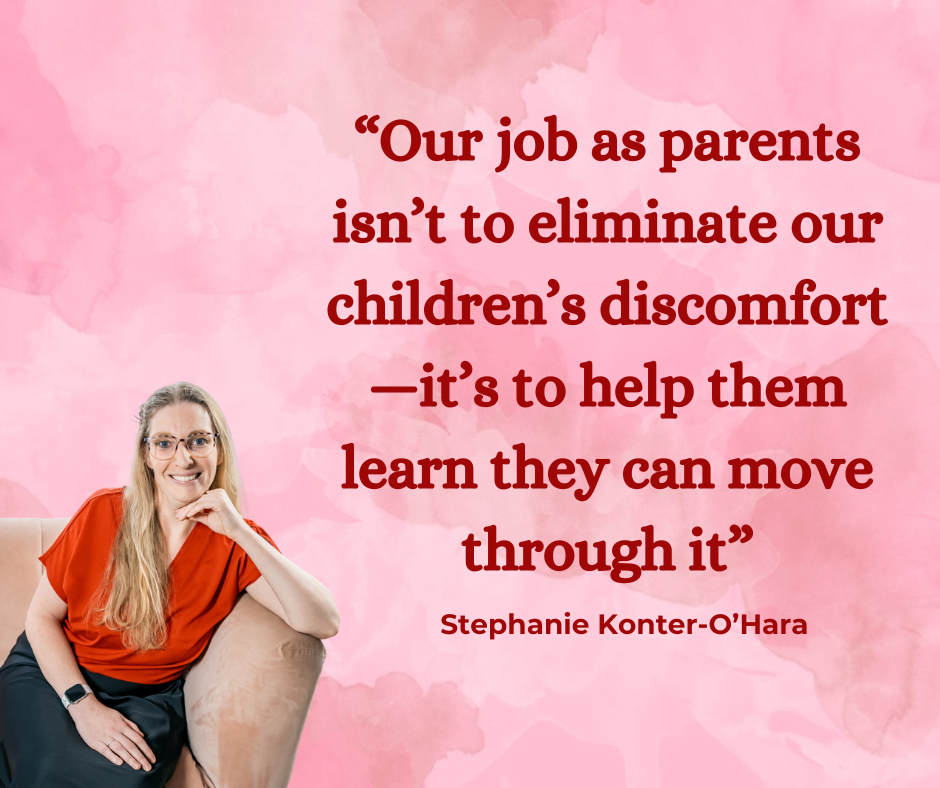
Stephanie invites us to look inward and ask a deeper question: Is this about my child’s needs… or my discomfort with their struggle?
Because often, the urge to fix isn’t just about helping, it can come from anxiety, urgency, or even a subconscious need to feel needed. And while stepping in may create immediate relief, it can also limit a child’s ability to build independence, resilience, and problem-solving skills over time.
Through relatable examples and grounded insight, Stephanie gently reframes what support can look like. Instead of doing things for our children, what if we stood beside them? Guiding instead of rescuing. Allowing space for trial and error. Letting natural consequences become teachers.
She also explores the delicate balance between protection and growth—acknowledging that while some moments do call for intervention, many are opportunities to let our children stretch, struggle, and ultimately succeed on their own.
Remember, discomfort isn’t always something to eliminate—it can be something to move through.
In the moments when we choose not to fix, we may be giving our children the valuable belief that they are capable.
-
This is Redefining Us, and I'm your host, Stephanie Konter-O'Hara licensed professional counselor. And I'm so glad that you joined us today so we can dive into what itmeans to be a woman in today's society. Figuring out how we balance everything, how we grow, how we be more authentically us, and figuring out who we are throughthe transitions of life, whether that be motherhood, success, relationships, and all things that happen in women's lives, because it's definitely not a linear journey. And Ithink by talking about it and normalizing it and validating, we can all arise together and be the women that we were meant to be. So keep tuning in, and I am so excitedabout joining the conversation and being in your ears each week. Let's get into it. So today we're gonna talk about something that I as myself, as a parent, struggle with.Something that I think a lot of people probably struggle with. So hopefully this resonates with you. So I have a toddler, as many of the listeners might know, and I findmyself oftentimes leaning into wanting to make her life easier or somehow solve all of her problems. And that's not really very helpful in the long run to most people, andit can create some confusion on their part as far as like who is in charge or of solving their problems or who to lean on to help them uh brainstorm and think through howto fix a problem. This often can be identified as what's called the fix-it syndrome. And it's an instinctual parenting reflex that I think a lot of people fall into. Like I said, it'san excessive tendency to solve, manage, or remove any of the children's discomforts or negative emotions in an attempt to rescue them, which inadvertently teaches themthat they aren't able to handle hard things or obstacles that might come to them. It oftentimes is a sign that you, as the parent, have a hard time experiencing your child'sown discomfort or frustration, and you aim to like stop the behavior that they're experiencing rather than validate the feelings. You yourself might fall into this identity ofhaving a savior complex. You want your children to look up to you as a protector, but that can that anxiety that you have as a parent might also come from a feeling ofneeding to be needed. So ways that you can maybe like think about this is an example of your child's maybe struggling to put on their shoes. And rather than going andrushing to do the shoes quickly so you can get out the door, which I know is like a common thing that people parents struggle with is like this urgency to leave, and theyjust want to like solve the problem as quickly as possible so they can leave rather than just like doing it for them, potentially guiding them and instructing them. So I foundmyself being like, let me just do it, let me just do it. It's faster, it's faster. But that's just like teaching them that they can do it. So allowing them to figure it out, even if ittakes an extra five minutes, like, okay, let you have the shoes on the wrong feet, like let's switch it. Or hey, you need to uh make sure the velcro is really tight, otherwiseyour your shoes are gonna fall off. Giving them simple instructions like that can be helpful, or just letting them face the negative consequences. Let's say they don't put thevelcro on very tightly and the shoe just slides off, right? Like, oh, okay, you know, your shoe just slid off. What do you think you can do about that? Oh, I need to put itback on and velcro it again, right? Letting your kids solve the problems. Again, this might be difficult if you feel like you're in a rush or there's some sort of like sidesocietal expectation or pressure to move through a problem quickly, but at the end of the day, that doesn't really teach your children how to solve things. I I find myselfdoing the fix it thing quickly when to me it feels like there's a safety thing involved. When really, if I taught her how to do the thing safely, she probably could do it thenext time or the time after that safely, rather than me having to come in and rescue her. I'll give you another example. We were at the playground and she was attempting toget off of the play structure from a higher than what I would consider safe space. And rather than instructing her to like roll on her belly and slide off by trying to get herfoot onto us the step that was below, just picked her up and put her on the ground and was like, Oh, Stephanie, like, how is she gonna learn if I just pick her up off the playstructure and put her on the ground? Or let's say she's too short to even reach this step rather than picking her up and putting her on the ground, instructing her to walkback down the steps so you can get all the way off the play structure safely, right? Or how do you think you can get down? Maybe when she is a little bit older and has likemore critical thinking. And maybe even in that moment she had those critical thinking skills. I just didn't allow for that time because I saw that she was attempting to getoff of a play structure from an unsafe vantage point. And so I find that when I lean into that piece of me of fixing it, it to me it comes from this place of like love andprotection, which I do want my child to feel, but there needs to be a balance of love and protection with like guidance and support and letting her struggle. And so notevery moment of every day do you need to be avoiding trying to, you know, jump in. But I do think if there's a balance between times when it feels like you quote unquoteneed to jump in or want to jump in, and then times when you allow your kids to struggle and and figure it out. Yeah, I mean, there's obviously different impacts on yourchildren that I've kind of already alluded to, but some of the impacts on children that are positive is that they do receive immediate relief and support. There's this bondthat develops when you help someone or guide someone and relieving them of their problems or their struggles. Negative consequences, though, is a lack of independence.Maybe they struggle to be super resilient because they had you jump in all the time, might find themselves anxious and dependent on you. They feel like they can't solveproblems or can't figure things out without your presence or without your input. And then they struggle to problem solve. So they may not be able to come up with threedifferent ways to solve the problem because their way of solving the problem historically has been calling mom or asking dad for help. So I think it's really important toask ourselves what are ways that we want to encourage independence? What are ways that maybe, let's say the shoe thing, going back to that, there doesn't feel like there'sany time to, you know, encourage them to figure out their shoes right before you leave. Maybe the time is you figure out their shoes at a time when you're just going out inthe backyard and there's no urgency to leave the house. And you let them struggle and get frustrated with trying to get their shoes on. Maybe at the playground, you ratherthan let them just jump off a really high space, you you know, tell them, hey, like I see that you want to jump off, and that might be fun, but that might also cause harm. Sowhat are other ways you think you can get down? And just encouraging them to think through or encouraging that independence to solve the problem or to um experiencethe struggle. You know, sometimes kids even just have struggles over being told no, right? Like, no, you can't go outside right now. And your child might kick and screamand fuss about that, but if it's actually not an appropriate time to go outside, then letting them just be upset with that, validate their feelings. I get it, it's upsetting. It'snighttime, it's rain, you can't go outside. Or, oh, it's too cold to go outside because you don't have a jacket on. Like, I'm sorry, we're not going outside. The snow and thewind are too much. And letting them be mad without feeling like, okay, fine, fine, fine, fine, fine. Let's get your boots on or let's get your coat on or whatever. Like ifyou've said no, letting them experiencing the disappointment of not being able to do the thing rather than feeling like you have to fold to do the thing. Now, I'm not sayingyou can never change your mind as a parent. You're not just changing your mind because your kids are having a meltdown and you just want to give in and not hear themmelt down anymore. You're actually changing your mind because you want to do the thing, or the thing in that moment feels like actually it's really not the end of theworld if we go outside in the rain and and stomp around in the puddles. So, and explaining that to your kid, like it's okay to change your mind sometimes. So, yeah, I saidno, but right now I think going outside and running around on the rain actually sounds like a good idea. So you've convinced me, or however you want to word it. So Ithink there's a balance and recognizing when to intervene and when to let go is a delicate balance for a lot of parents. And it teaches them to again, like it's okay to changetheir mind, it's okay to struggle a little bit and not have someone just jump in and fix things. Yeah. So those are my thoughts on that. And if you have any topics that you'dlike me to discuss or like me to dive into deeper, feel free to let me know in the comments. I'd be happy to engage with you all more in that way and um talk throughthings that you might be asking yourself. But yeah, I hope you found this little brief podcast about the fix it syndrome and my own experience with dealing with that. I'd bemore than happy to do other podcasts very similar to this. Thank you for tuning in to Redefining Us once again and share with other people so other people can continue tolisten to Redefining Us and we can get into more listeners' ears if you follow us or subscribe or leave a comment or review. That would be greatly helpful for other peopleto find us and also just for me to get some feedback. What do you guys want to hear me say? What do you women care about hearing? I'm totally open to bringing onguests and talking about topics that are unique and inspiring to everyone, so please let me know. And this year, hopefully we'll full of a lot of community building, a lot ofpublic speaking, a lot of resource sharing. So I really encourage you to follow us on social media at Law Minded Counseling on Instagram as our handle, as well as goingdirectly to our website, www.wellmindedcounseling.com backslash redefining us, so you can be in the know with all the things that are happening in the Redefining Uscommunity. Once again, thank you so much for listening and keeping awesome.