
Episode 39: Raising Kids Without Losing Yourself with Shea Guerra LeJeune
When we put the pressure on ourselves to be the perfect parent, we’re actually making parenting so much harder.
In this episode of Redefining Us, Stephanie Konter-O’Hara sits down with mental health and spiritual growth coach Shea Guerra LeJeune to talk honestly about the emotional realities of parenting—realities that often go unspoken. From identity shifts to guilt, exhaustion, and unrealistic expectations, Shea shares the tools she uses to help parents move from overwhelm into clarity and emotional peace.
Shea’s journey into coaching parents began with her own experience of becoming a mother. Having three children in three years—and eventually raising five kids—forced her to rethink everything she thought she knew about parenting. Like many parents, she found that the advice in books and podcasts often didn’t translate into real life. That realization led her to develop a more compassionate, individualized approach to supporting families.
One of the biggest themes in this conversation is the identity shift that happens when someone becomes a parent. Shea explains that many people enter parenthood expecting life to stay relatively the same—just with a baby added in. But the truth is that parenthood fundamentally changes priorities, schedules, and even personal values. Learning to accept that shift, rather than resist it, can be a turning point for many parents.
Shea also talks about the intense inner pressure many parents carry. Guilt, shame, and fear often show up in the form of harsh internal dialogue: Am I doing enough? Am I failing my kids? Through coaching, she helps parents unpack where those thoughts come from and question whether those standards actually serve them or their children.
One of Shea’s most practical tools for overwhelmed parents is identifying their “bare minimum.” Instead of trying to accomplish everything on a long to-do list, she encourages parents to decide what absolutely needs to happen on a tough day—maybe meals are served, dishes get done, and everyone gets through the day safely. Letting go of unrealistic expectations often opens the door for more creativity, flexibility, and enjoyment with children.
Another key shift Shea encourages is redefining what truly matters in parenting. Rather than focusing on perfectly organized homes or packed activity schedules, she prioritizes connection and rest. Research increasingly shows that overscheduled lifestyles can contribute to anxiety in children, while unstructured time allows space for creativity, play, and emotional regulation.
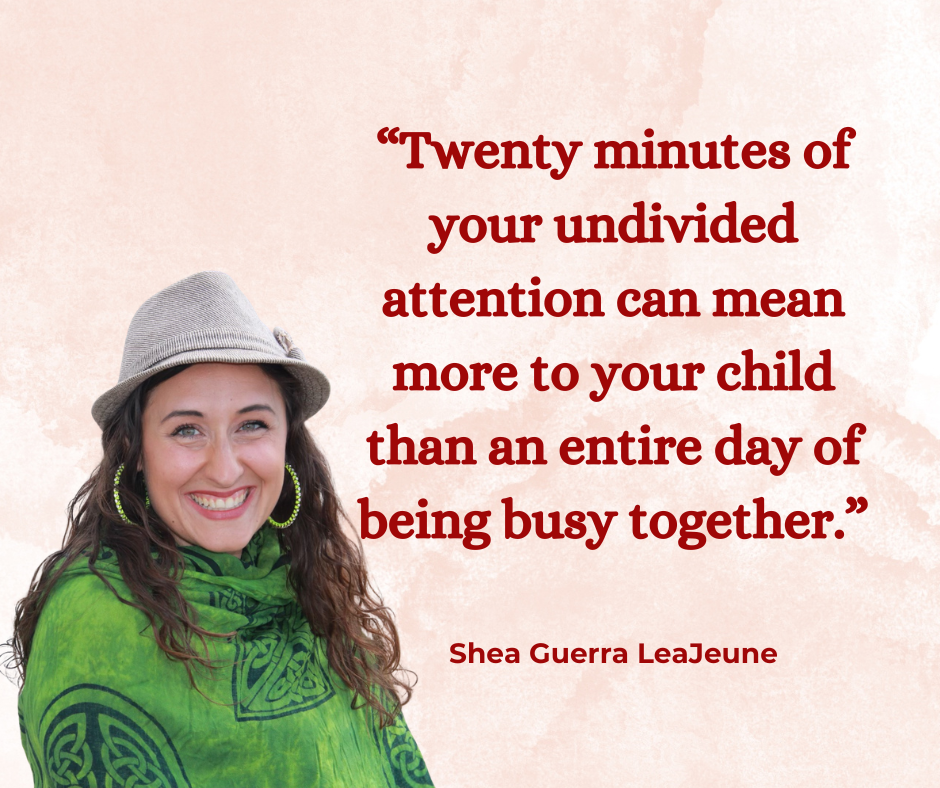
To nurture deeper relationships with her own kids, Shea shares a simple but powerful ritual she calls “specials.” Every few weeks, she spends about 20 minutes of one-on-one time with each child doing whatever activity they choose. This focused time helps children feel seen and valued, and it creates a pattern of connection that can continue into the teenage years and beyond.
Throughout the episode, Stephanie and Shea explore how modern parenting culture often pushes people toward constant productivity and performance. But Shea reminds listeners that parenting is not about perfection—it’s about presence.
By giving themselves permission to slow down, adjust expectations, and focus on connection, parents can build relationships with their children that are rooted in emotional safety, joy, and genuine closeness.
-
This is Redefining Us, and I'm your host, Stephanie Konter-O' Hara, licensed professional counselor. And I'm so glad that you joined us today so we can dive into what it means to be a woman in today's society. Figuring out how we balance everything, how we grow, how we be more authentically used, and figuring out who we are through the transitions of life, whether that be motherhood, success, relationships, and all things that happen in women's lives. Because it's definitely not a linear journey. And I think by talking about it and normalizing it and validating, we can all rise together and be the women that we were meant to be. So keep tuning in, and I am so excited about joining the conversation and being in your ears each week. Let's get into it. And I really think she has some great insights about being a mom, parenting with five little kids, and how that has really changed her life and the way that she thinks about motherhood. So I really hope that you enjoy this podcast. Well, thank you for being on today's Shay. Let's just jump right in. I know that you're a parent coach, but if you could please share with our listeners like what's specifically is like special about the way that you work with families.
Sure. I became a mother 12 years ago, and it was a game changer, as anyone who's a mother knows. It changes your literal identity as a person. You're now a mom for the rest of your life, and you have special neuroplasticity in those first few years as you adjust to this whole new life. And I essentially learned it trial by fire how to handle all of that and that I shouldn't do it alone. And like, what do I listen to that the doctors say? And what do I not listen to? And I had three kids within three years, and it was so intense that I really shifted my mental health coaching practice to parents because I realized that none of us are really taught how to handle the first few years of being a parent. We're told so many times over and over again what a joy it is and how fast it goes by and what a treasure it is to be a mom. And we're not taught a lot about the emotional challenges that we face, the hormonal fluctuations that are going to happen, how our body doesn't quote unquote bounce back, that we are forever changed and we're actually needing to step into a new identity that we did not previously have. So we actually won't be going back. And so I guess my mental health practice kind of shifted into helping parents specifically because I don't think I could find a lot of practical things out there that actually worked for my family.
Yeah. I imagine that lens of maybe thinking outside of the box or being more client-centered rather than just like do this prescription of how to take care of yourself was like really prominent in the way that you work with clients because of your own experience.
Definitely. And I love problem solving with people and reaching out to exactly where they're at physically, emotionally, spiritually, relationally. And I feel like some of the things that I was learning, I was reading parent books, listening to parent podcasts, and it was like, that is not realistic. That might have worked for my first kid or even my second, but it's certainly not going to work for my third kid or my fifth kid. And so I do feel like having five children also gives me five different kinds of archetypes to work from, which is also helpful. Generally, when I start describing one of my kids, any mom I'm talking to is gonna say, Oh, that sounds like this kid of mine. And obviously, every child is completely unique and every parent journey is unique, and you want to approach it from your own heart and soul, which is gonna be different. But it is really helpful to feel like someone gets where you're coming from, whether you have neurodivergent children or whether you have kids that don't fit the mold of what you expected them to be. And so I really like to meet parents where they're at.
Yeah, I think it's important to maybe highlight that idea that typically when people go into parenthood, they have maybe this like idea or like expectation of what their child might be like or how they're going to behave. And that probably, I don't know what the stats are, but it's like most likely not going to be the case. Yeah. And adjusting one's like own internal expectations in order to show up for your kiddo is a really big shift for parents to undertake.
And certainly the way I respond is different than I thought I would as well. So I had expectations of how I would show up as a mom and what that would look like. And it is a very different kind of mom than I actually am. And so there was this period of trying to measure up to that standard or that perfection, that model I had in my head of how I should be versus how I can actually show up in a healthy way. And so there was this whole wrestling of figuring out what that meant. I think one of the most prominent emotions in parents that I talk to is guilt and shame and fear. We're walking around with so much weight on our shoulders that it's hard to just have fun and be a parent that's able to be who they really are without all of these expectations, many of them self-imposed, that are actually not serving us or our kids. And so I think there's a whole journey there, not just the expectations of what your kids are gonna turn out like, but also who you thought you would be in a parental role and what the reality actually looks, looks like. And that's even more acute with parents who have to go through a divorce. And so I've worked with a few different parents going through that. And it's like, well, I can't show up how I thought I could show up. So what is this really gonna look like? Or I don't have a partner in this situation that I thought I had, or even people who are still married with their partner parents in a different way. And like, how do we mold these two things together? How do we figure out how to do this as a team? So there's a lot of that.
Yeah, I I guess I'm kind of curious, like, what is one of the main things you really talk to with parents? It sounds like first identifying shame and guilt and fear, but yeah, I'm kind of curious like what your process is of helping them identify that and then moving through that so they could maybe show up more as their authentic selves.
Yeah. I think a big, I mean, I think it works different with each person because we all work differently and think differently. But I would say a big part of it that was helpful for me and something I definitely bring to a lot of my clients is the concept of what is your bare minimum. So a lot of times we have seasons of flex and flow. We have times where we have a lot of energy and excitement and creativity. And then we have these other seasons where we're tired and we're stressed and we're worn out. And I think it's really important as a parent to identify what is your least amount you can do and still feel like everything's okay. And it's okay to have those days. Now, ideally, we're doing those days to take care of ourselves, like take a walk, do some meditation, connect with a friend instead of just veg out and binge because it actually doesn't end up usually helping. But having, okay, what do I have to have done today practically? And what can I let go until I have a different kind of day? And so for me, that was okay, there I'm gonna do the dishes, I'm gonna do one lead of laundry, and I just have to make sure that there's something to eat three times this day, depending on how old your kids are. And if they're still at home, I mean you got three meals and a snack or two, right? So it's like, okay, this is the bare minimum. I feed them and this is done and this is done, and then we're good. I don't need to worry about anything else. And sometimes taking off that pressure actually made me have more creative ideas and like, oh, maybe we could do this today, or maybe we could try that. Because I don't already have this preconceived notion of the things I need to accomplish in any given day that just make me end up feeling like a failure by the end of the day. Cause I did two out of five of the things I thought I wanted to tackle because there's so much unpredictability in parenting. And the big flex is flexibility. Well, one of them's vomiting, the other has diarrhea, and if you have a third in there, they're feeling perfectly healthy and want to go out. So it's like, how can we be flexible and adapt to the situation in a way that serves everyone at the same time while taking care of myself and my heart? So yeah.
Yeah. Yeah. I I think that idea of like trying to figure out what your I guess lowest threshold is is important because that way you can like give yourself grace for the times that you are at maybe your low threshold. Yeah. I I think parents and people in general, like oftentimes want to like do this comparison game or like judge themselves and feel like they're not doing enough. We have definitely like, especially in America, this society of let's always like one up ourselves or like one up the next person. It's like constantly like feeling like you need to perform or do better and better. And yeah, that stress is heavy on on parents, especially when things are not going as planned, whether it's your kids are sick or you are sick, or I don't know, you have just like a hormonal day, or your spouse argument. And so now you're like wanting to just like not speak to each other, whatever the energy is, like it could be all day today. And so allowing for that is probably very paramount in order to have like long-term wellness as a person and as a parent.
Yeah, it makes me think of the inner voice conversation, which I think most people are familiar with at this point. Thankfully, we have language for this now that is pretty broad-reaching, where if you're having that negative inner voice that's saying, you're not doing good enough, you're gonna fail your kids, you're a bad parent, whatever it is, it's really important to get to the why behind that so that we can eradicate it from the roots, or it's just gonna keep spreading and spreading like a mint weed in your yard. And except not smelling wonderful and being beautiful. Um, I had a client last night that we were kind of doing the why, why, why, why until we got to the very bottom of it. And then it was, and what? What can I do to change this? And a lot of times it might start with, I am a messy parent and I'm like failing as a parent because I'm messy or disorganized. Why is disorganization making me a bad parent? Because then everything's in chaos, which means I have anxiety, which means I can't show up for my kid emotionally because I'm so frustrated and feeling anxious. And then like it just sends you in a circle of, well, it's because I'm disorganized, right? So we just we just keep going on this circle mentally, but it traps us in that circle. So we can't ever get out of it. And so a lot of what my work does is go, okay, but why is that actually failing? Are you actually failing when you're messy or disorganized? Do you think your two-year-old really cares if your house is messy and organized? Who are you really thinking about? Who do you think you're actually failing? Is it yourself? Is it your mom? Is it your judgmental friend? And then kind of like unpacking that because that actually has nothing to do with your relationship with your kid. And something that I've valued more and more and more over the years is connection and rest. And so while I'm saying I don't need to do all this extra stuff sometimes, and then when I do have energy, I'd like to have a cleaner house. What matters more than my clean house or my educational activities or my creative outlets for my children that I've arranged this project or this field trip to a museum or whatever. What really matters in the long term is that I have connection with my kids and that we can rest together. And as kids, that's play. And as adults, that's fun or laughter. And a lot of times play is a struggle for us. So we have to kind of find play adjacent and get into play slowly because we've forgotten how to play. Yeah. But I think figuring out those two words that you value most in your motherhood will really, really help, or your fatherhood. And a lot of times that's stability, like emotional stability, or it's creating fun, or it's having friends involved, so it's like community. But like just finding those, it's like making it boiling it down to simplicity. That way, when all the noise tries to hit us and tell us that we're not doing it right, or maybe we didn't do it how we wanted to do it, or how we saw it in our heads, at least we have this very small window that says, Oh, wait, but I'm doing this though. Am I doing this? Let me recenter on what I actually value in this connection.
Yeah, I think what I noticed for myself, and I imagine maybe other people uh struggle with this, is kind of like this resistance to change. Like, uh, I don't know, I had these expectations that I was gonna like keep doing my life the same way that I was doing my life before, and that like adding a child to my life, not necessarily changing my life when I have a child. And, you know, I resisted that for probably a quite a while, and my anxiety would just like rise and my stress levels were, you know, at an all-time high. And then I came to this values work that you just kind of mentioned here about like what is actually important to me and how can I like adjust my life to those values rather than feeling like I'm giving up like my old life. And so yeah, it was uh I think it's hard work for people to realize that they do have to reconceptualize their life now that their life has changed. The addition of a child and every child, even after that. Like, I imagine not in this place, but I imagine you could probably speak to this more, but like adjusting to one child is one thing, and then you have potentially a second or potentially a third, and like every time there is another like life adjustment that takes place. It's not just like I know you mentioned like being a mom changed you forever, but I imagine like each time you are in a new mom to a new child, that also changes your life.
It definitely changes your life in your home. But I think that first one is is significant and uh just paramount significance. Like you said, you can't keep doing things like you did them before. I think a big part of that is it's okay to mourn your life that you've lost. And I think that's another thing that can easily catch us up in well, let's try to stay back to what we were, but we can't do that anymore. Darn it. And then it's like, oh, but I can't feel like I missed my old life because that's terrible, you know? And so there is like a letting go of the life that you had and a little bit of sorrow and mourning of like, I no longer have that freedom and that's a reality. But also, what can I accept in? So, what is my new life going to look like? Which can be kind of exciting because you get to start over and choose what that's gonna look like now as a parent. So I really do love that lens behind it. But you're right, a lot of people have the expectation of, yeah, it'll be fine. I'll just have a kid and maybe I'll sleep a little less, but I'll figure it out. It'll be pretty much the same. And it's it's fundamentally not true for I would say 90% of us. Just throwing out a random untame number. But I think most people are gonna realize not only did this change the way that their schedule and their life works, but it actually changes them as a human because things that used to be important aren't so much, and things that weren't as important now are.
Yes. And being okay with that, you know, I'm just gonna, I guess, share some like anecdotal information of, you know, I have people in my life that are like, oh, you know, like don't make excuses. Like, there's no reason to not show up as your best every day, or you know, there's no excuse for not making it to the gym, or there's no excuse for not doing X, Y, and Z. And it's like, how many bandwidths are you possibly able to have? Like, I remember my daughter got sick, and I had somebody in my professional life that was like disappointed that I didn't finish something on the timeline that I had originally said that I was going to. And like, you know, sharing with them, like, I didn't intend for my daughter to go to the emergency room. That really threw a wrench in literally everything that I had planned. So, like, I'm sorry that you're disappointed, but I'm only one human being, right? And so, and giving myself that permission because it's I imagine if I was in a different headspace, if I would have heard that person was a disappointed with me professionally because I didn't meet a deadline. I don't know. I feel like I could have easily spent time beating myself up and how I'm a horrible professional, and I can't believe that I've let this person down, right? Or like going the idea of going to the gym. I thought I'm a horrible, I don't care about my health because I'm not making it to the gym every single time that I told myself like all of these expectations that I think maybe the world puts on you, very easy to internalize. And it's like, no, your life is actually different. You can't do as much as you did before. Do it maybe not as much, but do it in the same way that you did it before.
I think if we all woke up tomorrow and said there's no rules and just said let them. I'm sure a lot of your audience know is familiar with the let them theory by Mel Robbins, but it's let them feel what they want, think what they want. If we were just able to let go of that, we'd feel a lot lighter. And we might even get more things done without the pressure. Because when we're carrying that stress, it's actually a mental burden, an emotional burden that we're carrying. It's weighing us down, it's making what we do create a lot of times forced or rushed. And I do think it's very Western to have this mentality of you have to have it all, and a little bit of that hypey language that you were alluding to, like, you can do it, there's no excuses, you've got this. Like that's a very uh almost our military language, very a lot of times referred to as a male energy, but it's like push through, knuckle down, put your head down and push through. And there is a place for that. But if that is our everyday life, then we are literally working in fight or flight most of the time. And we're not gonna be able to make our most reasoned decisions or have space for our most creative ideas or have any room to actually see another human for who they are and truly connect with them on a deeper level. Because if performance, if putting getting stuff done is is like the drive that's pushing us, pushing us, pushing us, we actually start to value humans less. Even if our doing is getting our kids to every activity and enrolling them in every camp and having them in every sport that they ever want to do. We think we're giving them so many opportunities. And yet the research is saying over and over and over again that these super busy lifestyles are actually creating anxiety in children. It used to be in high school and then middle school, and now it's going all the way down to elementary school. We're making our kids anxious because we have fear of them messing, missing out, and we are overscheduling. And so they're moving, moving, moving all the time. When kids are actually wired. To have space for boredom, which creates space for play, and play creates creativity and learning on a whole new level that sitting in a classroom reading a book just can't replicate. And so I don't do a lot. I have five kids. And so I get I get told all the time, oh, I bet you're going all the time. I bet you're so busy all the time. I bet you're driving around all the time. And I was like, actually, I'm not. And your nose can make room for your yeses. And so when I say no to a lot of things, I'm actually making space to say yes to something different. And one example of that is our specials, is what we call them. Specials. Um my dad took me on dates, but I have four boys, and they thought that was weird. So we came up with specials, which is from Thomas the Train. Actually, you get a special special if you do something good. And so I try to do a special with my kids. It's probably every two to three weeks. And I'll do three specials in a row one day and then two the next, so that each kid gets one on one time with me. Sometimes it's a no-money special, which means it has to be at somewhere in our house, and they can choose to have me play with them in whatever thing they want me to play. Even if it's playing pretend with little dolls, which I struggle with, whatever it is, or playing this crazy game that I really don't want to learn how to do because there's 1800 rules. But for their special, I will do whatever that thing is. And honestly, 20 minutes. 20 minutes to a child is so much longer than it is to an adult. So I started to realize that is not a sacrifice as much as it is a gift. And if I start these specials when they're six and they keep doing that until they're 12, then when we get to 15, 16, 17, it'll already be a part of our relationship that we both pause and take 20 minutes to spend together. And that's something that I can continue to initiate for the rest of their lives, rest of my life, I guess. Is oh, it's time for our little special. And if they live on another continent, maybe we have a 20-minute phone call. But that's already wired into the way that our relationship works. And no matter you're gonna parent each of your kids differently, that's a reality of parenting. But if they each know that they're gonna get that special time, it it changes the dynamic and the flow when they start to think, oh, that one's the favorite. Because kids are gonna do that. It's just gonna happen. And sometimes there might even be some truth to that. Maybe one of your kids is easier to hang out with than another kid. And so they feel that and they see that. And so it's really important to have a counterbalance to that. Like, I do have this time for you. Let's do this. And sometimes the kid that needs the most attention is the one that's being the craziest and the most annoying. When they're being really, really annoying and you know it's on purpose, they probably need 20 minutes with just the two of you. And the moment you set your entire focus on them and their face, they're probably gonna shake shift. Because that's probably what they really needed.
Yeah, and recognizing that like maybe you both needed even like a time to reconnect and have have fun with each other so you can like re Yeah, like slow down and enjoy each other's time and like relearn to center with the other one.
Yeah. And sometimes we forget to miss it. Cause if we're just going, going, going, we might go a month and be like, oh my goodness, I don't even know what's going on in your little world right now. Especially as they get older and they hit the end of elementary and get into middle school. It's so easy to just drift through, okay, well, we ate dinner together or I put you to bed. But I haven't actually talked to you and ask you how your friend was doing. You told me about your friend or that class you didn't like or whatever. And so we try to create built-in opportunities for that kind of connection. And that will look different in every family and on every family value system. But I think it is important to actually schedule that connection because the nature of our world is that if it's not chosen and on the schedule, it will probably get filled with something else.
For sure. Going back to how everyone's life is so scheduled and busy all the time.
Yeah. No thanks.
Yeah. Well, I would love for you to share with everyone how they can reach out to you and connect with you if they want to work on with work with you one-on-one.
Sure. Yeah. My website is Shaycoaching.com and it's Shay Like Shay Butter, S-H-E-A coaching.com. And that's an easy way to just click and uh schedule an initial call. You can find me on all the socials. Certainly look me up from first and last name. My last name is Wonky, so double check that spelling. But I'm sure that Stephanie will leave links to that. Um, I'm I love working with clients one-on-one, especially when they're feeling anxious, depressed, they hit a brick wall, they don't know what to do next, they're running out of ideas, they're feeling super discouraged or frustrated. That is exactly when I like working with people because it means that they're fed up with the way things were going and they're ready to try something new. And so I am not a therapist, I am a coach. So it's very goal-oriented, results-oriented, and clients generally graduate from working with me after a hurdle. And then they might reach out a few years later with a new challenge. But um, generally it's for a short period of time until they get to where they want to be and have the tools that they need to traverse that challenge.
Well, thank you so much for sharing your specialty and your words of wisdom. I really appreciate you taking time to talk with me today.
Oh, and if you want to know more about me, read my book. So it's on Amazon. It's called Becoming Shay. And it's just, yeah, Shay, Leah, Garrill, Legern, because I have the longest author name possible. Um, but again, it's the S-H-E-A. So Becoming Shay is on Amazon and it really takes a deep dive into my story, my history with memoir, but also gives you deep introspective questions at the end of every chapter to kind of unpack some things in your own life. And you'll definitely know after you read the book whether or not you want to work with me. You'll be able to tell if I'm your vibe and your energy or not. And I really want every person who wants support to be able to find the right fit for them.
Well, thank you. Yeah, all that information will be on the website in the show notes. So all the links to her book as well as her website will be there. So head over there if you know weren't able to take down the spelling of her name and yeah, every be there.
So thank you. Awesome. Thank you so much, Stephanie. I really enjoy talking to you.
Thank you for tuning in to Redefining Us once again and share with other people so other people can continue to listen to Redefining Us, and we can get into more listeners' ears if you follow us or subscribe or leave a comment or review. That would be greatly helpful for other people to find us, and also just for me to get some feedback. What do you guys want to hear me say? What do you women care about sharing? I'm totally open to bringing on guests and talking about topics that are maybe inspiring to everyone, so please let me know. And this year, hopefully we've pulled a lot of community building, a lot of public speaking, a lot of resource sharing. So I really encourage you to follow us on social media at one minded counseling on Instagram as our handle, as well as going directly to our website, walkmindcounseling.com backslash redefining us, so you can be in the know with all the things that are happening in the Redefining Us community. Once again, thank you so much for listening and keeping awesome.