Episode 32: Navigating Your Identity Through Values Work
What happens when the roles you care about most start competing for your time, energy, and sense of identity?
In this solo episode, Stephanie opens up about the tension she felt stepping into motherhood while still wanting to show up fully as a therapist, a partner, and an individual with her own needs and dreams.
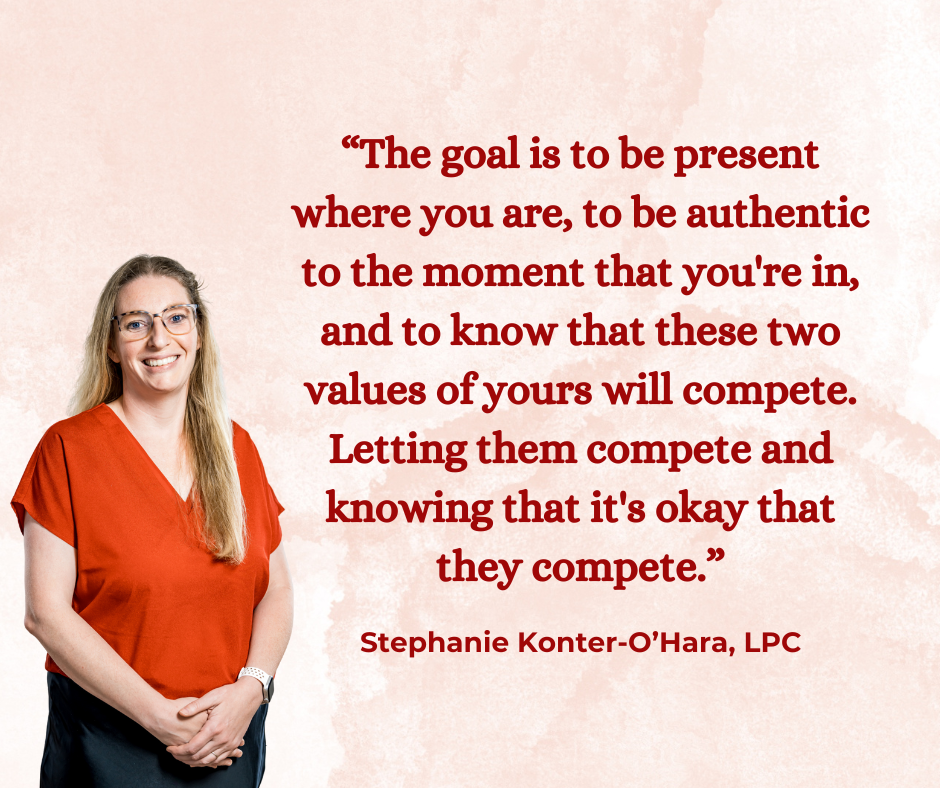
As she worked through this in therapy, Stephanie began to understand why everything felt so overwhelming. Independence and connection kept showing up as her core values, and recognizing that helped her make sense of the guilt and pressure she had been carrying. Instead of trying to perfect every role, she started grounding herself in what mattered most.
Stephanie offers a gentle reminder that alignment brings more ease than perfection ever could, and this episode is an invitation to explore what truly matters to you, especially when life feels like a tug of war.
-
Welcome to Redefine Us, where we explore sexuality, identity, motherhood, and mental health to help women thrive authentically. Let's break free fromroles that limit us and create a life where you can truly be yourself. Welcome back everyone. Today I'm gonna do a solo episode. And if you've listened to me longenough on this podcast or have heard some of my guest spots, I talk a lot about values. And values has really helped me align more with myself. There is a type oftherapy called acceptance commitment therapy that I began doing with my therapist post-birth about maybe a year after I had my daughter, because I was stillfinding myself really feeling unsure of who this new version of me was. And I want to take a deep dive into that today. Some of the things I want to explore arevalues that have helped me prioritize the competing demands that I have in my life between work, my partner, my daughter, friends, other responsibilities, thevalues that maybe connect it to my identity as a core. I think that was really the biggest thing that I was struggling with. As well as what values help me reduce theguilt and comparison trap that I feel like we are also guilty of falling into, whether it's during motherhood or during other seasons of our life, comparison's a thiefof all joy, as they say in that quote. So I'm gonna really dive into the competing demands piece because I think that influences the identity piece. Prior to becominga mom, I still am a therapist, uh, as well as a business owner. And that role, that position in life, I really had accepted as my identity. And it was like a hat that Iwore pretty frequently. And I think when the mom hat started to need to also fit on my head, I had this push-pull between the two of them. This, well, I'm atherapist and boss and business owner, and I'm also a mom. Like, how do I hold all of these very precious responsibilities and somehow do it all? I felt a great,great responsibility to my clients to show up as my best therapist self. And I had a great sense of responsibility to show up with to my employees as the best bossand supervisor as I can be. And I really felt like I was, I'm gonna use the word failing. I hate using that word because I think it's toxic, but I really felt like I wasfailing at both of those roles when I came back from maternity leave because my mind felt like it was elsewhere. And then when I was with my daughter, I felt likemy mind was elsewhere. It was like no matter where I was, I was trying to be in the other place. I was trying to do the other thing that I know that I needed to dowhile doing the thing that was right in front of me. It was a real, real struggle. And I just remember feeling like so confused about how do I do both of these thingsthat are so important to me and so deeply linked to how I feel about myself and my self-worth, so deeply linked to how I wanted to show up in the world and thedifference that I felt like I was called to make. And it was really overwhelming. Needless to say, even just talking about it and trying to tap back into how I feltduring that time. I feel like this anxiety creeping up in my chest. And my therapist at the time was like, well, all of those things you can value. You don't have tonecessarily kick one off in order to serve the other. The goal is to be present where you are, to be authentic to the moment that you're in, and to know that these twovalues of yours will compete and letting them compete, and knowing that it's okay that they compete. I was like, oh no, they can't compete. What do you mean it'sokay? It's like both of those things are things that you're going to need to manage in your life. Your role as a mother, your role as a boss, your role as a therapist.Those are all things that are gonna constantly compete. And how do you decide moment to moment which role takes precedent rather than feeling like they all needto be number one all at once? And I was like, oh, oh, okay, yeah. And then, of course, my role as a partner is also valuable to me, and that was greatly sufferingbecause I was really struggling between these other two things that felt like if I didn't pay attention to them, something bad would happen. I had this security in myrelationship that if I didn't pay 100% attention to it, I knew nothing bad was going to happen. But part of my anxiety really was like, if I don't pay attention to mydaughter, something bad's gonna happen. If I don't pay attention to work, something bad is gonna happen. If I don't pay attention to my clients, something bad isgonna happen. And I just had this fear that crept in and these intrusive thoughts that just would not quiet down. And so we started doing a lot of values work, and Isorted out my values using a value sort card. You can get this deck of value cards. You can also make some downloadable, printable ones on the internet that Irecommend you look up. But it's just this little deck, and you go through, and there's 56 different cards in that deck. There's some value sorts that have more thanthat. I would stay less than 75 because it's gonna get overwhelming, and a lot of them have a decent amount of overlap. So we sorted the cards and we sorted thecards week after week. Finally got down to five core values. And the ones that really spoke to me actually were my top two. And these top two values began to bereally apparent on why they were my top two, which is independence and connection. Both of those values actually come into play when it comes to these rolesthat I was holding so tightly. And what was a good mental shift for me was recognizing that my values were in competition with one another, not so much myroles. Because I didn't want to say that I was trading off my role as a mother for my role as a business person, or my role as a business person for my role as amother. That felt for some reason full of guilt and grossness to me. But when I shifted and reframed the perspective that it's actually independence and connectionthat are in competition with one another, it felt lighter, it felt more doable because in each of those roles, I want both of those values. But sometimes one of thosevalues is going to take precedent because in a lot of ways they're in opposition of one another, right? Like I so deeply want to be seen and to feel independent, tofeel free, to feel like a leader, to feel strong. Like the that's what independence means to me. And then connection is I want to be present, I want to relate, I want tohave deep, meaningful relationships. I want to provide secure attachments. And those two things may sound like they're in contradiction, but they feel like theyboth need to be present in order for me, like myself, Stephanie, to exist in congruence with myself and in alignment with myself. Now, I again recommend that youdo this exercise, figure out which values are your top. But for me, those two things were in this, I guess, power struggle with one another, because I felt like I couldonly have one or the other. And shifting away from the identities and into the values was a good shift. And then realizing, like, wait, maybe it's not like one of themis one and one of them is two, or one of them is, you know, needs to be a 10, the other needs to be a zero. Like, what if it's like one A and one B? The differencebetween the two of them doesn't need to be so great. What if they just interchange easily? Kind of like, you know, two balls just going back and forth with oneanother as someone's juggling them. They don't need to stay in one place, neither one is more important, neither one is going to be seen as the pinnacle. They'reboth priorities that are constantly dancing with one another. And again, that allowed me to have some sort of relief, that realization that I could redefine what beingindependent meant, redefine what being connected meant and all of my roles. My role with my partner, my role with my daughter, my role with my work, my rolewith my employees. It really helped alleviate this mental strain that I had to choose. And knowing that they could be balls that I'm just juggling and that are shiftingback and forth that are in flow with one another, not in contradiction with one another. Again, just like alleviated a lot of anxiety. So, again, I hope that you coulddo that exercise either with yourself or find a good therapist to do it, because I highly recommend it. And this really helped me sort out the identity that I had as amom. Because I think I also was trying to figure out like who am I in this new role? Like, I know who I am as a therapist, I know who I am as a boss, but who am Iwhen it comes to being this little girl's mom? And I didn't know that answer, but I think as time went on, and again, staying in therapy, talking to my therapist, Irecognized that my values are who I am. I don't need to become somebody else or become something else. I just need to lean into these core values of mine andexude them and maybe impress upon my relationship with my daughter and guide myself and her through these values. So I want to be connected to my daughter.My daughter wants to be held. Okay, let's hold each other. I want my daughter to be independent. Okay, no, you don't need to hold my hand. You can you can walkover here by yourself. And allowing those two things again, even though they feel contradictory, it's like this push-pull again. But I think that those values allowedme to show up as a mom that I wanted to be, both fostering a connection between the two of us, that secure attachment that I so desperately wanted to foster, aswell as that strong independence. Like the first I remember we got this swing set for my daughter's second birthday. And I was really scared, to be honest, of like,oh my goodness, she's gonna break an arm. Oh my goodness, she's gonna break a leg. And the first few times my nurturing connected self was like, I'm gonnastand behind her as she climbs up the ladder. And this girl, no fear, just climbs up the ladder. I'm like, great, I've been doing something right, or at least I haven'tbeen letting my anxiety crush her her feisty spirit. So yeah, she just climbed up the ladder, climbed up the ladder, and I stood behind her maybe the first 10, 15times until I felt confident walking away. And now she just goes up and down the slide in the ladder, like no problem. She zooms right down. And I'm so proud ofher every time she does it because she really does have what feels like no fear for a little two-year-old. But that was that balance of I need to stay connected withher by staying behind as she climbs up the ladder, and then over time allow her to be independent and do it, and not feel like I have to keep staying in one value oranother. Like I can hold both as it feels right and aligned with me. And hopefully that teaches her to do the same. Like, oh, this feels like I need my mom. I'mgonna ask for help. This feels like I can do it by myself. I'm gonna do it by myself, and really trying to foster, like, yes, I can ask for help, and also I can do it bymyself sometimes. And that's, I guess, what I feel like I started really leaning into as my values of parenting. And again, you might have other values that come upwhen you do the value card sort, but it's important to pay attention to how those show up. There's other moms that might value, I don't know, something else. Idon't want to assume, but let's just say their value is something else. Maybe they would show up in that situation that I just described with the place at in a differentway. And that's fine. It's like showing up as your authentic self in parenting that will help you feel most at ease and also will give your child a congruent idea abouthow you're going to show up for them and how they're going to show up in the world. It's not about trying to do everything the way that everybody else is doing it,coming full circle to that comparison thing that I mentioned at the beginning. It's about doing it in a way that feels aligned with you. Because if you're in alignmentwith yourself and you're being authentic with yourself, then your child knows who you are. They're not confused about what to expect from mom or dad. Theyknow what to expect because in every scenario, you're showing up the same way, or at least in congruence with the way that feels aligned with you. And that'swhat's going to help them create a secure attachment. It's not necessarily, oh, I need to, I don't know. I'm just going to use something random here as an example.And this is no shade to anybody who believes this because you do, girl. Mommy is hard. Like I need to read three stories to them every night. That's going to createa secure attachment. I need to hold their hand while they fall asleep. That's going to create a secure attachment. And you know what? It might. And you knowwhat? If someone else doesn't do that, that doesn't mean that they're not forming a secure attachment with their child. Something else that they're doing, hopefully,with consistency and authenticity, is creating a secure attachment with their child. So I had gotten in my head as a therapist, like so obsessed with this idea ofcreating secure attachment. That was like driving myself crazy. So leading into this authentic values-based parenting really helped me feel more in alignment withmyself and took off this pressure of doing quote unquote what the parenting books say is right. Because all of that can be exhausting. And I'm not saying there's novalue in parenting books because I think there are. We can get really, as humans, laser focused on thinking one way and seeing things in one way for our own easeand structure and being introduced to new ideas, it can be helpful and can diversify our approach. So I think that is also value. Just like you're listening to thispodcast and taking in my perspective here. But there is no one right way, no one right perspective. I think again, if you can go back to what feels like it's inalignment with you, take what you want, leave what you don't. Allow yourself to be challenged by new ideas, consider them, take what you want from that idea,leave what you don't after some critical thinking. So maybe like trial and error. All of this helps you move the needle to the type of parent, hopefully, and the typeof mom that you want to be, and the type of person that you're evolving into as you become a mom. And I feel like every day you just become more and morecloser to that version of yourself, hopefully, that you want to be as you do this introspective work on who you are now as a mother or as a parent. Because the workcan be really complicated and layered, going back to what I the first thing that I said, with guilt in comparison. People often find that they're asking themselves, amI doing enough? And maybe the question instead should, am I living in alignment with what matters to me? That simple shift of, am I doing enough? Am I doingenough this? Am I doing enough that? Am I a good enough parent? Am I a good enough mom? Am I a good enough housekeeper, etc., etc.? That list can becomereally long and is littered with guilt and shame all over it. And so if you begin to ask yourself this question of, am I living in alignment with what matters to me?That is so much more powerful and empowering and again authentic to maybe who you are, then asking yourself if you're good enough for X, Y, and Z or if you'redoing enough. It's just light year's different. So I encourage you to try to change some of the language when you're speaking to yourself about how you're showingup or how you want to show up, and just speak in a framework that helps you be supportive to who you already are and be in alignment with who you already are. Ihope his podcast help illuminate some new tips or skills that you can use. Share a little backstory about why I think this work is so important and about how I'vekind of gotten to where I am in my motherhood journey, and how I think it could be helpful for you to practice this idea of focusing on alignment rather than doingthings perfect or doing things right, because right and perfect are traps to set you up to fall right into that toxic failure mindset. So I hope that you all have a goodrest of your day and that you got something from this. All right, take care. Thank you for tuning in to Redefining Us once again and share with other people soother people can continue to listen to Redefining Us, and we can get into more listeners if you follow us or subscribe or leave a comment or review. That would begreatly helpful for other people to find us, and also just for me to get some feedback. What do you guys want to hear me say? What do you women care about here?I'm totally Open to bringing on guests and talking about topics that are unique and inspiring to everyone. So please let me know. And this year, hopefully, it'll befull of a lot of community building, a lot of public speaking, a lot of resource sharing. So I really encourage you to follow us on social media at WellmindedCounseling on Instagram as our handle, as well as going directly to our website, wellmindcounseling.com, backslash redefining Python us, so you can be in theknow with all the things that are happening in the Redefining Us community. Once again, thank you so much for listening and keeping awesome.