Episode 31: Postpartum Healing Through Connection and Nourishment with Radha Crawley
What would postpartum care look like if it centered the wellbeing of the mother just as much as the baby?
In this conversation, Stephanie sits down with Radha Crawley, Ayurvedic Postpartum Doula and Educator, to explore what true nourishment, community, and holistic support can look like during the most sensitive phases of a woman’s life. From her early experiences as a young mother to the profound impact of midwifery care, Radha shares how her journey shaped a deep commitment to returning warmth, connection, and compassion to postpartum spaces.
Radha walks through the principles of Ayurvedic postpartum care, the importance of ceremony and grounding practices, and why community support is not simply a luxury but a form of emotional and physical medicine. She and Stephanie talk about what modern families are missing, how isolation has become the norm, and the healing that becomes possible when mothers feel held rather than rushed or dismissed.
They also explore the realities of parenting through different life stages, the need for proactive support, and the patterns of disconnection that so many families face. Through Radha’s personal stories and grounded wisdom, this episode offers a gentle but powerful reminder that healing begins with care, slowness, and community.
Whether you are in the postpartum season, preparing for it, or supporting someone who is, this conversation invites you to imagine a different way of caring for families, one rooted in nourishment, belonging, and deep respect for the mother’s journey.
-
Welcome to Redefine Us, where we explore sexuality, identity, motherhood, and mental health to help women thrive authentically. Let's break free from roles that limit us and create a life where you can truly be yourself. In today's episode, we're gonna dive into all things are you fake, as well as postpartum doula care and some of Rada's backstory. I'm really excited for you to get to know her, and she shares a lot about how she came to be in this career and what she's hoping to give to other mothers in the work that she does and in the training that she does to other doula's. So I'm really excited for you to hear today's episode. Welcome back to Redefining Us. I'm your host, Stephanie Contra-O'Hara, and today I have with me Radha. Mm-hmm. Yes. Yeah, so welcome to Redefining Us. I'm so happy that you agreed to be on today. We've only met one time previously, but it was so lovely, and I felt like we just needed to connect further. So thank you for agreeing to be here today.
Yeah, thank you so much for having me.
Yeah, so let's dive right into it. You have a story about why you've come down this path to teach other people about how to be Ayurvedic postpartum doulas. But let's start at the beginning of where that journey started.
Absolutely. I love to share this story. So interesting how in the moment in life things feel like they don't make any sense. And then when you look back, you're like, oh, that's why that happened. So it's really fun to share this story with you. So I became a mom pretty young in my life. I was 21 when I became pregnant with my oldest. And I really like to say that she kind of set me on this journey of a beautiful, holistic life and helped me really seek out things that were deeply nourishing and care forward. And when I was a young mom, I hadn't been around many postpartum people at all, or pregnant mamas at all, or really children. I was the only child. And so the extent of me being exposed to babies was like friends of friends, you know, um, siblings or something like that. And so having a baby pretty young was um, I was like a deer in headlights, basically. Obviously, didn't know much what was happening to me and didn't have tons of support at the time. And so I just started to do what, you know, everyone tells you to do, which is go see an OBGYN, get your prenatal vitamins, you know, and be on your way. And so one of my early visits with a Western medical doctor, I went in, had the blood draw, you know, he came into the room. You know, I'm in the little gown, he checks me out, says everything looks good. Um, do you have any questions? And I just was like, Oh, I have a million questions, but I don't know what they are. Like, I don't know what to ask. Right? It's crazy. And I sort of was like, I don't think so. I do, but I don't know. And so he left the room and sent me to the lab to get blood drawn. And I went to get my blood drawn, and they took like seven or ten vials and a lot of vials of blood, and they were like, Okay, well, go schedule your next appointment. And so I walked up to the front and I just started to feel like really dizzy and kind of overwhelmed. And uh, next thing I know, they're, you know, shouting my name and where I am and at me, and I had passed out essentially, you know, fallen flat on the floor. And my poor husband was like, I just want to just scream, someone get a doctor, you know. And so we came out of that and they gave me some crackers and juice and and whatnot and sent me on my way. And and then a few weeks later, I was talking with a neighbor of mine, and she was older and didn't have any children, but had some a close friend who had birthed recently at home with a midwife, and she asked me, Have I ever heard of a midwife? And I said, No. And she said, Well, you should meet with this midwife, and I think you'd really like her. And so I did. I went, my husband and I went and met with this midwife, and I had a very similar experience where I started to feel kind of dizzy and overwhelmed. And this midwife, her name was Stacy, bless her heart. She um just kind of swept me up and laid me down on this beautiful, you know, quilted little twin bed she had in her office and dimmed the lights and made tea and was like massaging my feet. And yeah, I never passed out. And I had such a huge aha moment in that time of like this deep level of care that I didn't even know I needed, but just felt like home, you know, really felt like that's exactly how people should be cared for. And yeah, so it sent me on this trajectory of just looking at my life, you know, in that moment, I thought, oh, I could have a birth where I'm falling on the floor, or I could have a birth where I'm held in care. And so I did end up having the midwife. I had a beautiful home birth, no complications, and felt really supported in this community. We had a another child three and a half years later. And yeah, we're very much like lived in this community where breastfeeding was very common, and people would bring meals and exchange child care, and kids would be running around naked in the summer through shrinkles and you know, just like the whole thing. And then when my oldest was nine, we moved away, and I was in a new community in Arizona where it was just like stark difference. And, you know, that whole time we were living in Wisconsin, I had been studying holistic health and Ayurveda, and I became a birth doula and and all of these things that felt really nourishing to support my family and my community with. And then, you know, in Arizona, I had this huge aha, like, wow, this isn't the common care. Like I think I was in this illusion that uh so many communities were like that and that that families had support and that families had, you know, meals dropped off. And I saw a lot of women in postpartum and families left alone and under-resourced. And so yeah, I just felt really, really called to being in that space to help support and hold, hold these families and listen and talk to mamas and connect them with other professionals in the community and be a sounding board for their concerns and their worries and helping nourish them from that moment on. And yeah, I feel so strongly that if every single family had this kind of care in postpartum and, you know, really warmth and nourishment through warming foods and support, you know, community around them and bod, uh, all of these things, that we could really create a peaceful world from that first initial six weeks is like when these babies are, you know, really developing their level of ability to create oxytocin in their brain and their hormonal system. And so moms are stressed, babies are stressed, and then babies hold that stress in their nervous system for, you know, a long time, maybe their whole lives, their receptors are set up for that kind of cortisol instead of oxytocin. And and so I feel really strongly like we could really help change the trajectory of the world with this care. Yeah.
I'm just like, I guess, feeling like everything that you just said in so many ways, like the idea that your first experience was like, oh, but questions do you have? But you're so finding yourself feeling so overwhelmed, you don't even know what question to ask. And even just from my communications with all the people that have been on this podcast, you know, hearing that like providers, generally speaking, like have removed themselves from that like education piece. So it's like if you're not educated on what's going to happen, like how do you even ask the right questions? How do you know what you need if the options aren't even like available to you? But sounds like this midwife really well, one like held you, but also probably like talked you through what the experience was going to potentially be like, and all of your options, and yeah, just kind of provided what feels like more of a um entire experience that like enveloped you in a positive way rather than just oh, come back next week and we'll like check your cervix again and we'll see you then. Have a good day. Totally, yeah. I'll come in, then I'll call you, and only if it's negative, like otherwise you're good to go.
Right? Yeah, she required all of her clients to take the Bradley Method course with her or with someone else, or something like that. So, some sort of like in-depth childbirth education. And yeah, I mean, my husband and I got pregnant pretty early on in our relationship, and so our relationship was like defined then by this like we got to know each other through this childbirth education course, you know, and what a gift. I mean, I learned so much in that class. Like, I was amazed and then sort of mad that I didn't know that beforehand, you know. I'm like, wee, I'm a woman. I like barely even know about my cycle, you know, and and so um it was definitely like a coming home to myself and my body and like empowering me to like I had zero doubts, and this could have been because I was young too and naive, but I literally had zero doubts that like home birth was not gonna work, or like I just knew I'm like, yeah, baby will be born at home, everything's gonna be healthy, like I'm doing all these things, and I just I I feel sort of like wow, I can't believe I I had that experience where I didn't have any fears, or I was so comforted by the level of care I got and like the the education that was provided in that moment, and like you said, like you don't know what you don't know, like there's no way to know what kind of questions to ask if you've never done something before. You're like uh yeah, exactly.
And you know, I'm definitely not like a stats expert, but from what I've read and heard, like the more medicalized birth becomes, the more risk of complications arise. So I imagine that also, like maybe or maybe not, like infiltrated your brain of like, oh, well, we're gonna not gonna have a lot of medical interventions because we're gonna do it at home. So like maybe there's less things to be worried about. Yeah, I don't know if you can like speak to that or whether or not you were just like, oh, there's this woman that I deeply trust, and she's gonna be there. Maybe both. I'm not sure.
Yeah, I think it was a little of both for sure. And then, you know, just really trusting my body. I think that part, you know. I read one of the first childbirth books I read was The Spiritual Midwifery by Ina Mae Gaskin. I don't know if you've seen that original one. It's a hoot. I highly recommend reading it. It was like written in the 70s, and so the language in it is like everything's groovy and like, you know, rad and stuff like that. So it's kind of funny to read anyway. But what was so beautiful about it is like, you know, she's she in her career, I don't know what she's up to now for how many births she's assisted, but like literally almost zero transfers, like no hardly any complications. Like it was like a full book of stories that of of how you know babies were born and in this natural way, and when the chemical cascade was allowed to proceed. And and just, you know, and I think that can happen in a hospital too, in a child in a birth center, but I really feel like the piece that's missing is that care, you know, the the deep care that we're all craving. Like we're all craving that like warmth and that someone to actually just sit and ask us questions and like have time to listen and have time to reflect back to us and mirror us with like a stable nervous system and just be a safe space. I just feel like that is so, so lacking in our in our communities. And and you know, in postpartum time, like women are like really raw and very vulnerable and are going through this, like maybe for the first time in their life. And things come up that as much as you can prepare, like life tends to give you the complete opposite. So then they're sitting there like, wait, I thought it was gonna be this way, but now this is presenting and I don't know what to do. And if they don't have someone that they trust they can reach out to that has time to listen, or you know, doesn't necessarily have that warmth that I feel like, especially in postpartum time, women need. Yeah, there's can be so much like missed opportunities in those early windows.
Yeah. I I mean, I'll speak to my experience just a little bit here, but like in my mind, and maybe in a lot of other women's minds, I was like, oh, my partner is gonna be all those things. Like they're gonna be supportive, they're gonna be there, they're gonna help me with all these things. And I definitely think my husband did, and many husbands probably do as much as they can, but they also just went through something like life-changing, like there's sleepless nights for them, there's stress for them, there's like all of the things are happening to them too, in a maybe a different capacity, but still they're in the trenches, and so the idea of a postpartum doula or like other support people specifically, like in that postpartum period, I feel like could come in and like care for the whole family in a different way than two adults who are just trying to like keep this little child alive. You know, like some thousand percent rather than just like, oh, you know, we're really trying to make sure this child stays alive. That's one of the reasons why I really started this podcast. And I know listeners who've been listening since the beginning probably really know this, but like the journey of becoming a parent in itself, it needs support and this time and healing and this space to really come in and hold parents, hold moms in this way. So yeah, I guess that's another reason why I was really called to have you on because that's exactly what you do now with your your work.
Yeah, yeah, it's so true that I mean, I think about you know what you said about you know, just trying to keep the baby alive, like the two people, but then there's also like your house. Like I can't believe how much work a house takes to keep going. And if you have pets or forget it, like you know, so yeah, it it's you know unfair of us to think that our partners can do that, you know, fully, because like you said, they also went through something, they are becoming a new, you know, parent as well, and they just probably witnessed the most intense thing of their life seeing their baby be born. I remember so I had two babies and then I became a birth doula. And I at my first birth that I attended was a home birth, everything was fine, baby was healthy, mom was healthy. I just left that birth and cried my eyes out because I was like, wow, moms actually have the better role in that whole birth thing because they get the hormonal cascade that like gives them, you know, all the pain relief and like the altered consciousness and whatever, and like everyone else is just an adrenaline. Like I was just thinking, like, okay, so so if you think about that, like the partner just came out of this like really intense birth witnessing their partner, you know, be in states they've never even thought possible for the physical body, right? And it's a lot to ask of them to completely know, and they don't know too, like what to do fully. Like we're not taught. So that's another level, too, is like teaching both parents. Like, here's what to generally expect in postpartum, and here's what's normal, and here's like red flags, and here's how to really set yourself up for success and get yourself some support. You know, that's the first question I always ask is who's your support team when baby comes? And it's so good to take that pressure off the partner. And yeah, I agree. This care needs to go on, like, yes, the first six weeks and first eight weeks is really important, but then so are I mean, I want to just like laugh and say, so are the first 18 years, you know. Like every phase has like a need of you know, new learning because I feel like every time I get used to my kids being, I'm like, okay, I got this. They're in this phase, challenge comes, I learn, I grow, and then they change like instantly. So then I have to do it all again.
Yeah, I've heard from people say like postpartum is like forever. It's not just the the first year, the first two years. Maybe your hormones like resettle and your body is quote unquote physically healed from the the process of birth. And I'm using quotes because I feel like there could be lasting issues, unfortunately. Generally speaking, those are the guidelines, but I do think that like, yeah, like what you just said is so true. Like, yeah, you're still being a parent for the very first time to this human who is uniquely them at the age of 10, uniquely them at the age of 15, uniquely them at the age of 20. So even if you have multiple children, like you're still parenting this individual differently, like every day in every stage.
Absolutely. It's so true. I mean, having two children, I can tell you they're so different. I mean, they have some similarities, but man, they are like completely opposites in other ways. And it's so in Ayurveda, we have these three windows of time in a woman's life where she can really up-level her health. I sort of think of the Mario Brothers game, you know, back from the 90s, where like Mario's going along and he gets a little mushroom and it makes him bigger, you know, and then he's invincible. It's like that. So we have this time where we can really boost ourselves and like become somewhat invincible to to illness, like moving forward. But if we don't pay attention to that time, so it's menses, postpartum, and menopause window, we can become really depleted and and really lacking. And I'm experiencing like now perimenopause time parenting too, like young adults, and that's like a whole nother topic that you know we could talk about because like I'm going through in some ways my second puberty, like my hormones are all over the place, and I feel like there's more information coming forward now, but there's still a lot that we don't know about about this time, and every single body and person is different. And how do we still show up for our families and our kids? And like in this time when we're you know changing so much as women, it's like a whole nother episode we could have together.
I really like oh man, the layers of that onion don't know cover this in one episode, but yes, I think the hormonal shifts, and then they're also like I imagine, especially if you have teenagers, like this kind of like mirror situation happening. They often relate people who are maybe not often people who are in this world, I think, not necessarily everyone, like relate becoming a mom, like matrescence to adolescence, right? There's like that similarity that has been drawn, but it's like, okay, now there's this whole other time too after becoming a mom where you're probably going through perimenopause while your children are also going through their hormonal changes as a teenager. So it's like, yeah, how to manage everyone's mental health at the same time. Yeah. That I think is like a uniquely, it could be like an entire series, probably, of episodes on the fire.
Right. Yeah. And I mean, it really like what comes back for me is just like, I think we're very under-resourced. Like, even those of us who are in this work and doing it, like I can speak for myself and just say, like, there's been times where I've confronted some challenge, parenting, or like in my own health. And I'm like, I don't even know who to ask right now. Like, I feel like, oh my gosh, like, where's my support net? Where's my team of people? You know? And I think that's really like at the core of the work that I offer is just like screaming from the rooftops, like how much we need community care, and how much we need this, these like networks of people supporting each other. And before the problem comes up or the challenge comes up, so that we actually know where to go. And like we have that list of of people, or like we've already established that relationship. And yeah, we just like we really need each other, like, especially in this crazy world right now.
I wish in general that society as a whole is more in the mindset of like proactive and like education and like you said, like community care. I feel like it's just been set up to be like this reactive, last minute, urgent crisis response. Thousand percent. Which is just like devastating because you can't catch everybody when they're in a crisis, right? You can't support people when they're maybe at a place where they feel like I'm the only one going through this. Whether it's like no, for me in postpartum, I was like, I'm the only one that feels like this right now. And I'm like, wait a second, Stephanie. Actually, do you know some other moms who've said this before, right? But like, if I wasn't connected to those and I wasn't connected to a community, I might be in the position late at night, two in the morning, breastfeeding, thinking to myself, like, what am I doing? I'm failing at this. And I hadn't heard other women or been connected to other people who are going through this process. I might have thought, like, yep, that's it. I'm the only one, and like it be have devastating results. So a thousand percent. Yeah to a community and people, I think, is so life-saving in so many ways, you know, from a spiritual, from a mental, from a physical sense.
I can totally relate to that in my own life. I mean, I, you know, said I was a young mom and I didn't have a ton of support. Like our families were kind of like, what are you guys doing? All because we were very like alternative for 25 years ago. My oldest just turned 25. So we were, you know, no plastic toys, no, you know, polyester clothing, um, organic food, like Waldorf education. And that was really weird back then. In the mainstream, especially in the Midwest where we lived, right? Yeah. And so I really leaned into my community for support. And I remember uh these library story hours that this librarian had every week, and she was they were Waldorf inspired, so she had like little, you know, felted puppets and cute little, you know, things and stories and silks and all of that. And I would go every single week with both girls, and I swear to you, that saved my life because I met so many other moms there, and like it was just so sweet, and like the girls loved it, and they would do a little craft afterwards, and like I could have a moment of like not being the only parent on, you know, and like let the community hold them for an hour or two or whatever it was. And I swear that saved me my mental health so tremendously much back then, and yeah, so I completely agree. I think like having connections with other, with other moms and other families when especially when our kids are young and we are like so in it with the laundry and the food and the naps and the all the things. Oh, it's a lot. It's all encompassing. We in we you don't really realize how much work and how stressful it is until you like have a moment to stop and like step back and like say someone comes in to offer care and you're like, oh my gosh, like I just want to sleep. I mean, I've had plenty of moms in postpartum time hire me, and then I get to their house and like we have ideas of things we're gonna do, you know, for her wellness. And she's like, actually, I need a nap. I'm like, yeah, you do. Go take a nap, you know. It's uh it's pretty tremendous the amount that you know, we're really not meant to do alone. And here, here we are, like in our little isolated families.
Yeah, I feel like society is just getting more and more isolated, right? Especially with, you know, I'll speak again for myself, like living across the country from my parents, living across the country from my in-laws, like just not having the same, maybe like home base that people historically have had, whether, or like even being removed from like communities that are spiritual in nature, right? And like being less for myself, I'll speak for myself, like less connected to like a spiritual community or like a religious community, just kind of end up being like, Oh, I guess it's just like me and my friends, and we're all parents at the same exact time, then they have, you know, small children. Like, how do you tap them in? Whereas in previous times, or even like with your services and other people's services that are in support of this, like having people who are not all in the same phase at the same time is also like really helpful. Like having other women come in or you know, other people come in to support the family, I think, yeah, it's just something we don't have in our current society, like already established community.
Thousand percent. Yeah, it's really, I mean, when you look at almost every other culture, you know, for sure, India, where Ayurveda comes from, Mexico, you know, Latin America, I mean, so many places, Russia, um, Bali, Indonesia, Japan, China, they all have postpartum things that they all do. It's like in their culture, like the everyone just knows, okay, when so-and-so has a baby, then we make this porridge, and then we bring this soup, and then the grandma comes and stays for six weeks or whatever it is. And she's trained in, you know, in India, like the grandmother or auntie or sister or cousin or neighbor or whoever, some woman of the uh that knows the mother will come in and give the mom warm oil massage every day for 40 days, and baby too. And you know, that has benefits of like opening up the channels so life force energy can flow through and tissues can heal faster, and fluids can move, and lymphatic can move through the body faster. Your organs can come back into place easier, there's less like pelvic floor issues, your nervous system downregulates, all the there's a million benefits, right? Of touch and and yet, and like you said, it's like it's the family that shows up, it's the people, and we're so, you know, in the United States, especially very isolated. I mean, our whole country was set up on independence, right? And like doing it ourselves, kind of energy, and and that's really doing a huge disservice to families nowadays.
I mean, yeah, we've almost taken it too far, right? Like if there's like a pendulum, right? We're over here in this like side where we're like completely quote unquote independent from one another, can't even you know, not to get political, but we can barely like share you know ideas about how the world should work. We're also like, this is the way that it should be, yelling at each other from the rooftops, rather than like being over here in this place where it's like, yeah, we all have like a little bit of differences and we all have our own like unique expressions, but like we're still hold the same values and beliefs and cultural identities and you know, historical, cultural like stories and traditions that are passed on.
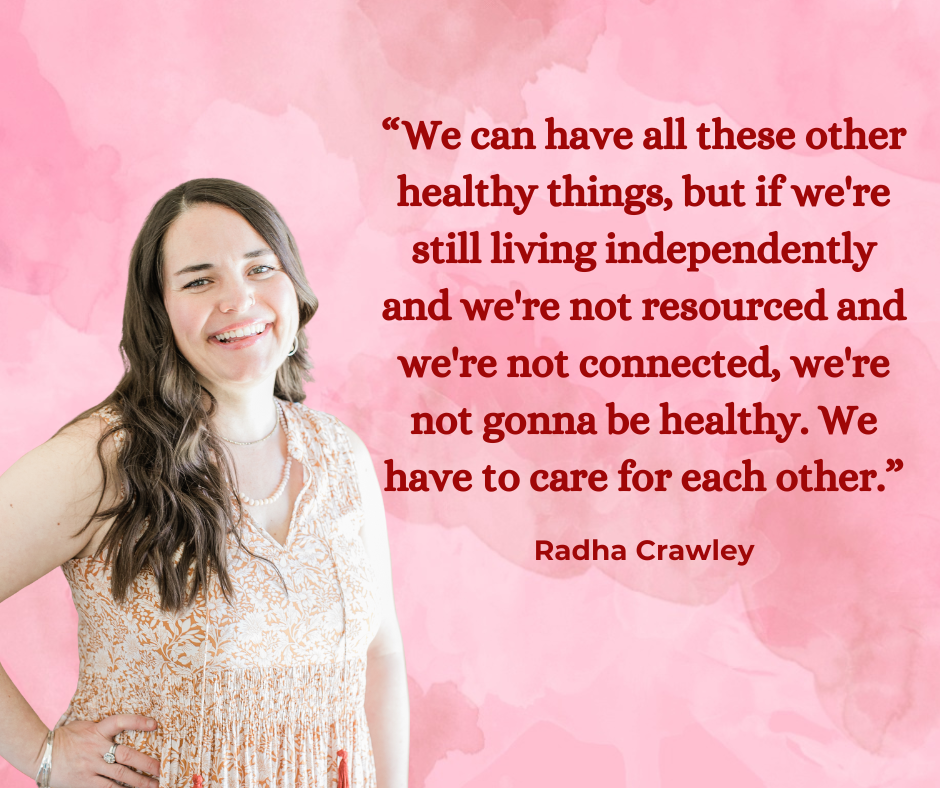
Totally. And really, I think in that space of like, yes, we're all, you know, we have differences about us, it's because we are talking to each other and we actually know what those differences are. And we can see that, like, I can talk to you, and if you have a completely different view on raising your children than I do, I can still like respect you and and be like, yeah, she's doing her best in her life. And instead of like shutting you out and like saying you're bad and like, you know, then go vote on some law that would prevent you from parenting your kids in some way or whatever, there's that deeper understanding when we're in community, right? Because we sit next to someone who's crying because they lost their child because they didn't have adequate health care, and like we're holding their hand and we're like, wow, I can feel empathy for you. And instead of it being this, like across the screen, you know, across the social media where we're like losing that like compassion, we're losing that empathy for each other. And yeah, there's so there's like so many studies coming out now. I'm sure you've seen them about like the number one thing that really boosts longevity and human health and in life is not diet, it's not exercise, it's not, you know, whatever else we say, like what herbs or pharmaceuticals we're taking, but it's actually community in our relationships. And so we can have all these other healthy things, but if we're still living independently and we're not resourced and we're not connected, we we're not gonna be healthy. Like we have to care for each other, we just do. Yeah, we have to swoop each other up and lay each other down on quilted blankets and serve each other tea. We just have to, yeah. I I agree.
Yeah, I think what I was also thinking back to, and we maybe already moved on from this point, but I just want to like I guess go back to it about like the idea that like uh an auntie or grandma or whoever would come in and do those massages. Yeah, I think the only like traditions that like really I know about in American culture is like, oh, you're pregnant, let's have a baby shower. Oh, we're pregnant, like Wendy wants to visit. Like, should we get shots afterwards? And like maybe that's not even a conversation, right? So it's like, what traditions do really exist to support new parents, whether it's your first child or your third child, like fifth child, whatever, like not a ton that are like established, like routine, like this is just what happens.
Totally. I mean, and the baby shower was just like capitalism, right? It's just like I mean, and you don't need 99% of the things that you get. I mean, sure, every family needs like a car seat and like maybe a stroller and some onesies and diapers, but beyond that, like newborns don't need much. They just need them like a parent to hold them and um warmth, you know. And so, yeah, the the cultural practices we have in our country is they're pretty scarce. And hopefully, like, I don't know, just I feel so lucky that you know you invited me on this podcast because this is what I want to share is like this mess message of there's other ways of doing things that feel more nourishing for our spirit, our soul, our you know, deep in our being, that part of us that like craves something, we're just like, ugh, something feels off. I don't know what it is, like that's it. We're craving this like deeper experience. We're craving this to be seen, to be held, to be cared for, to be acknowledged. Even when we're at our worst, or like, you know, we're in postpartum, like leaking all the fluids, sitting in adult diapers, you know, like we need to be loved in all the moments. And especially when we're when we're having a hard time and we're struggling. And that's especially when we need to know that people will be there for us and um feeding us porridge.
Yeah. Yeah. So I was hoping you could share what does Ayurvedic care look like in postpartum for people who are maybe not familiar with that at all.
Yeah, great question. So Ayurveda is it means the science of life and it's a form of health care from India. It's more people probably know of Chinese medicine, you know, with acupuncture and uh Chinese herbs, and it's very similar, but obviously a little bit different from India. And so we look at the five elements, and in postpartum, the element that we're trying to balance is the air and ether elements, which can create, you know, cold and space in the body, and which can lead to more of the postpartum depression or postpartum mood disorders or insomnia or excessive thoughts or things of that nature. And so all of the care in Ayurvedic postpartum is catered to balancing that, and that is warm oil massages. So there's a lovely herbal oils that we use to pour on the body to help open up the lymphatic system and ground, like I mentioned earlier, the nervous system. There's foods that you know are very warming and uh easy to digest. So sweet potato ginger soups. You can think of like chai spices and rice porridge, and there's some really lovely teas and almond milks with cardamom and dates that we feed to mamas in postpartum. And then there's some of the ceremonial pieces. So like the closing of the six or eight-week journey in postpartum, we will honor that time in whatever way feels true to the mom. And all of the care is really focused. It's like mom-centric, which is very different than like, say, traditional postpartum doulas, where they're more like helping the household, which is also very, very needed. Like, of course, we all know how much care a house needs. Um, so Ayurvedic postpartum care is more focused on the mom and like the her journey or their journey towards healing. And it can look very different for everyone, but again, active listening is a big part of it. I like to do just like some oracle card readings and some aromatherapy to help the mind body balance, herbal foot baths, some uni steaming, some pelvic floor care, all can be a part of it. But yeah, that that just showing up again and and being a person who's there to nourish that mama and that birthing person in that first six weeks is really what's most important.
Yeah, I I know you mentioned like the the first six weeks is really what your care focuses on, but I I imagine, and maybe this is wrong, but the first six weeks really sets you up for success, hopefully for the next six weeks. And then six weeks after that, but are there like additional services or other people that you would maybe refer people to if maybe they're out of that first six weeks, but they're still like, man, I really need healing or I really need support that feels like I need to come back to myself. Yeah, I'm kind of curious if either you or you know other people that provide that kind of service too. Cause I think, yeah, I don't want to have someone listen to this and they're like eight weeks postpartum and they're like, oh man, I missed my shot.
Totally, absolutely. You know, I actually work with with mamas like anytime postpartum. So, like you said, postpartum never ends. And so I actually worked with a mama recently who was going through breast cancer treatment and she was like being put in menopause a little early. And so um we did a postpartum type package. And what's cool about this work is that it's very like I was mentioning, it balances air and ether. Air and ether are present pretty much always in our world because it's basically movement, right? It's cold and it's movement, which is all we're doing in our culture now, is like we have all this information coming at us and we're constantly doing things. And then, you know, we live in Colorado, so it's like everyone's always running up the mountains, and like, you know, there's like all of this dryness in this movement. And so honestly, this care is like amazing for anyone in any transition, like in any time where, like you said, someone feels like they're disconnected from themselves or they're feeling like they need deep nourishment. This care is for that time. And so you're totally right, it's not just that for six weeks. I think it is amazing. I mean, I've treated people of all ages with this kind of care. I've delivered meals for surgeries, I've delivered meals for sickness, for all kinds of different times of life where somebody, you know, lost a job or went through a divorce or whatever it might be that is a transition type of time because it's very unsettling to be in transition, right? To whatever that might be. And this care is meant to ground and nourish and warm and soothe and calm and rejuvenate your body. And so, yeah, I mean, I would, I would recommend it really for anybody going through any kind of transition. Thank you for asking that.
Yeah, I just think there's like you've already kind of highlighted here, like so many times where people really need to remember that they're also capable of like receiving support. Cause I know a lot of moms and women out there that are probably listening to this podcast are tend to be the givers, right? Tend to be the people out there like being selfless and supporting other people. And like sounds like your care is like really meant to help wrap them up in a nice warm blanket and like allow them to receive care in a way that's really healing.
Totally, really super healing, and it is really hard, you know. I think that's part of the cell that kind of is tricky to get people to buy into is like because of our independent culture and our and how we're kind of taught like from when we're little to like do it yourself. You know, I'm a big girl, I can do it myself, kind of vibe, you know. And we actually can't. I'm sorry to tell you. We we can, but at what cost? Yeah, right. And that's the thing that we just have to surrender to. Like, we cannot do it all. Like, we cannot have the job, be a perfect parent, have a perfect house, go on all the vacations, have perfect health all at the same time, unless we're supported and resourced.
And even then, I'm like, oh, can you really do all of those things? I've seen plenty of like these like reels on social media saying things like, okay, so you expect yourself to have this, this, and this, and this. Like, how do you how do you possibly be perfect in all of those things at the same time? It's like, yeah, that's pretty unrealistic.
It's pretty unrealistic, and yet we think we can and we try, and then we beat ourselves up when we can't get there, and we won't give to ourselves, we won't allow ourselves to receive. And you know, it's so important to receive and whatever that looks like for you, like asking for someone to cook a meal for you when you're sick. Like, how have you ever done that? Like, that's hard to ask for. It's like, hey, me and my husband have the flu. We have two little kids, and uh uh they're about to go down too, I'm sure. Like, can you bring us some soup? Like, we you know, we don't necessarily feel comfortable doing that as a culture.
Yeah, it's really interesting. Not to like toot my own horn, but I've had some people and around me go through some difficult times, especially after having a kid and me being like, hey, can I help? And they're like, Um, let me think about it.
And I'm like, think about it. What do you what is there to think about? Let me go over.
Yeah.
What do you mean?
But there's like this like hesitation that people have of like accepting help that whether it's their own idea that they're gonna be a burden, whether they're thinking that their situation's not bad enough, quote unquote, to need help, whether it's pride. Like, I'm sure there's probably plenty of reasons why people resist receiving, but I don't know, this is your sign that you should allow yourself to receive because it's such like a warm feeling for yourself and it fills you up, so then you can go and fill other people up. And it's like this the cycle that didn't just continue.
My gosh, so much. I I know. So this community where my daughters were born, we just had this understanding that when someone had a baby, like you didn't even have to know them. Like you would get on their mail train and bring them food. Like, oh, you know, so and so's neighbor had a baby. Okay, like when can I bring soup? Like it wasn't even a question. And when I moved here, I just noticed that wasn't so common. It was just like reserved for like their friends, close friends that would bring food. And I was like, Well, can I bring a meal? And people would look at me like, what? Like, I'm like, Yeah, they're in the community, like I wanna help. And yeah, I think if we all did that, like, how can we like I love that how you just said, Can I help? Can I do something? Like, if we all had that mentality, like that would just open the door, right? Because sometimes you don't even know what you need, and you're like, crap, I just had a baby, and like it was like me with the doctor. I don't know what questions to ask, I don't know what help I need.
Yeah. And this is kind of a uh related but almost like a tangential thought. I think that there would be less anxiety and less depression if not just moms, but like the community, like knew that other people would be there for them. That like you don't have to do this by yourself. I think there's so many people that live out there just like scared or worried that like they don't know where their next meal will come from, or they don't know who's gonna help them if their car breaks down, or well, they're gonna get paid for their cat's vet bills, or you know, all of these things that like people are always just like worried about. And then, of course, just like this internal feeling of like I'm not good enough because I can't figure this out by myself, or I'm not good enough because I can't solve all these problems alone. So let's all remember that we're not supposed to be doing all these things by ourselves and having to do it all alone.
Totally. Can you imagine like a thousand years ago if people all lived isolated, just in their little couples, like all over? Like, I don't think be here today because we would have all been eaten by something. You know, we banded together in like a community to like support each other and like keep each other safe and feed each other and care for each other.
And what the heck do we and even though like we still all live in these quote unquote communities, I can't tell you that I know most of my neighbors. I was in the spot the other day as I was driving down my street, and I live in a neighborhood where it there's a lot of people, right? It's not like where houses are super far apart, right? Like it's like hi neighbor, you're right there. So like I was just thinking to myself, like, there's so many people that live in this tiny little area. And yet I can guarantee you that most of us don't know each other. Yep. Same in my neighborhood. And so it's like they're all living their lives literally right next to each other. And they could be strangers.
Yeah, it's not okay.
Um how we break down these walls is a whole systematic problem. But yeah, yeah, another podcast for another day, but I mean it speaks to this idea that like going out there and supporting each other is really helpful, and people go through hard times and people go through very natural times too, like becoming a mother that needs support. So there doesn't need to be a problem in order for there to be support.
I love that. That needs to be a bumper sticker. Yeah, it's so true. It's so true, it's so beautiful. And I love this conversation and really hope that it inspires whoever listens to, you know, give something to your community, maybe someone you don't know, like offer a meal with a new baby, or when someone's sick, or whatever it might be, like shovel someone's sidewalk in the winter or whatever it might be. It's just like all of it makes a difference. It really does.
Yeah. Well, I'd love for you to share with people how they can connect with you. And then yeah, if you have any asks as far as like supporting you back.
Yeah. If you want to connect with me, you can find me on Instagram, bliss underscore alchemy. And my also personal account is at Rodha Schwaller on Instagram. And then my website is blissalchemy.net, and you can read about my offerings there. I do also offer holistic facials here in the boulder area, and it's a very mind-body-spirit experience. And so I really like the time and slowness of a session with someone to really drop in deeply and nourish your mind, body, and skin. And then also, yeah, I have this uh Ayurvedic postpartum doula program that runs online uh about three times a year, depending on how the cycles go. And it's nine modules, it's a four and a half, five month program, and we really go through all the aspects of how to support families in postpartum, and as we learned in this conversation, also in all kinds of other transitionary moments in life. So it's not just for postpartum doulas, I would say. Um, if you're looking to nourish your clients, your family, your community with Ayurveda, it's a really beautiful course for that. Yeah, so come find me. I love people reaching out. If you had any questions from this conversation, I'm happy to answer, chat more about anything. Yeah, we just all need each other. So thank you so much for having me, Stephanie. It's a pleasure to chat with you today. I'm so happy that you're able to come on today. I appreciate it.
Thank you for tuning in to Redefining Us once again and share with other people so other people can continue to listen to Redefining Us and we can get into more listeners' ears. If you follow us or subscribe or leave a comment or review, that would be greatly helpful for other people to find us, and also just for me to get some feedback. What do you guys want to hear me say? What do you women care about here? I'm totally open to bringing on guests and talking about topics that are unique and inspiring to everyone, so please let me know. And this year, hopefully we're full of a lot of community building, a lot of public speaking, a lot of resource sharing. So I really encourage you to follow us on social media at Wellminded Counseling on Instagram as our handle, as well as going directly to our website, wallmindedcounseling.com backslash redefining, type in us, so you can be in the know with all the things that are happening in the Redefining Us community. Once again, thank you so much for listening and keeping awesome.